

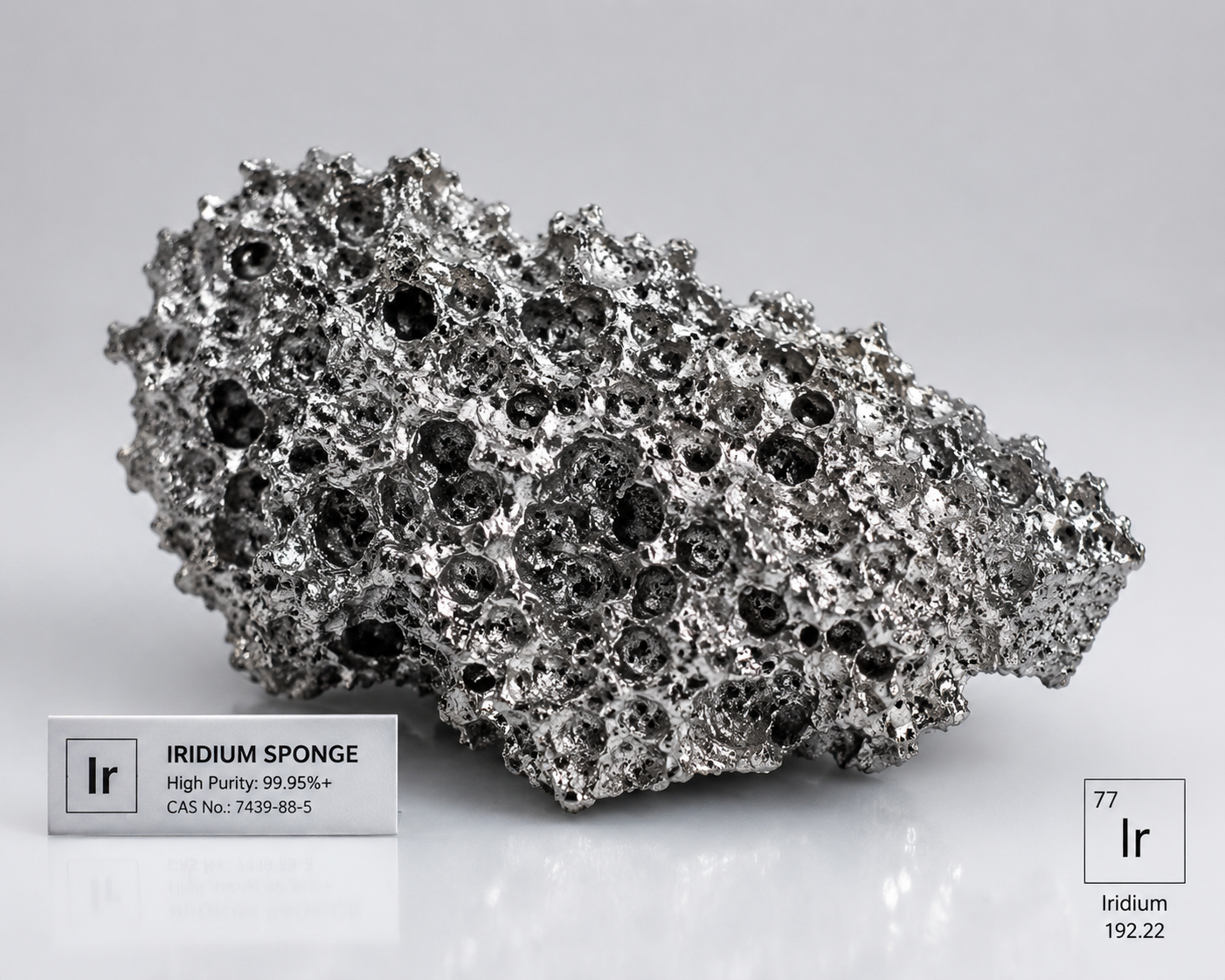
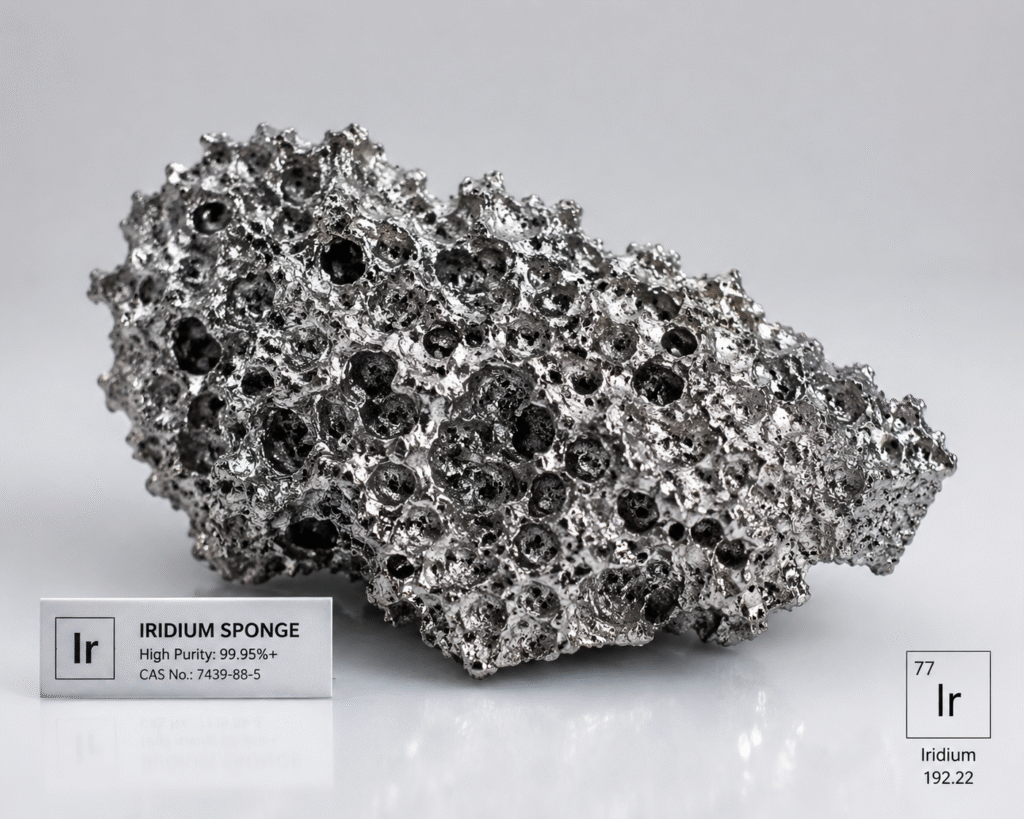
Recovering the Unrecoverable: Advanced Iridium Recycling Technologies and Industry Recovery Rates

Introduction
Iridium, the rarest and most chemically inert of the platinum group metals (PGMs), is a critical enabler of technologies that operate at the extremes of temperature, corrosion, and wear. From the crucibles that grow laser crystals to the anode coatings that drive the chlor-alkali industry, iridium’s unique properties are irreplaceable. However, the very chemical stability that makes iridium so valuable also makes its end-of-life recovery one of the greatest technical challenges in precious metals refining. At [Company Name], we specialize in overcoming this challenge, deploying a suite of advanced pyro- and hydrometallurgical processes to maximize iridium circularity. This article outlines the dominant recycling technologies and provides a transparent overview of current industry recovery rates.
1. The Iridium Recycling Technology Portfolio
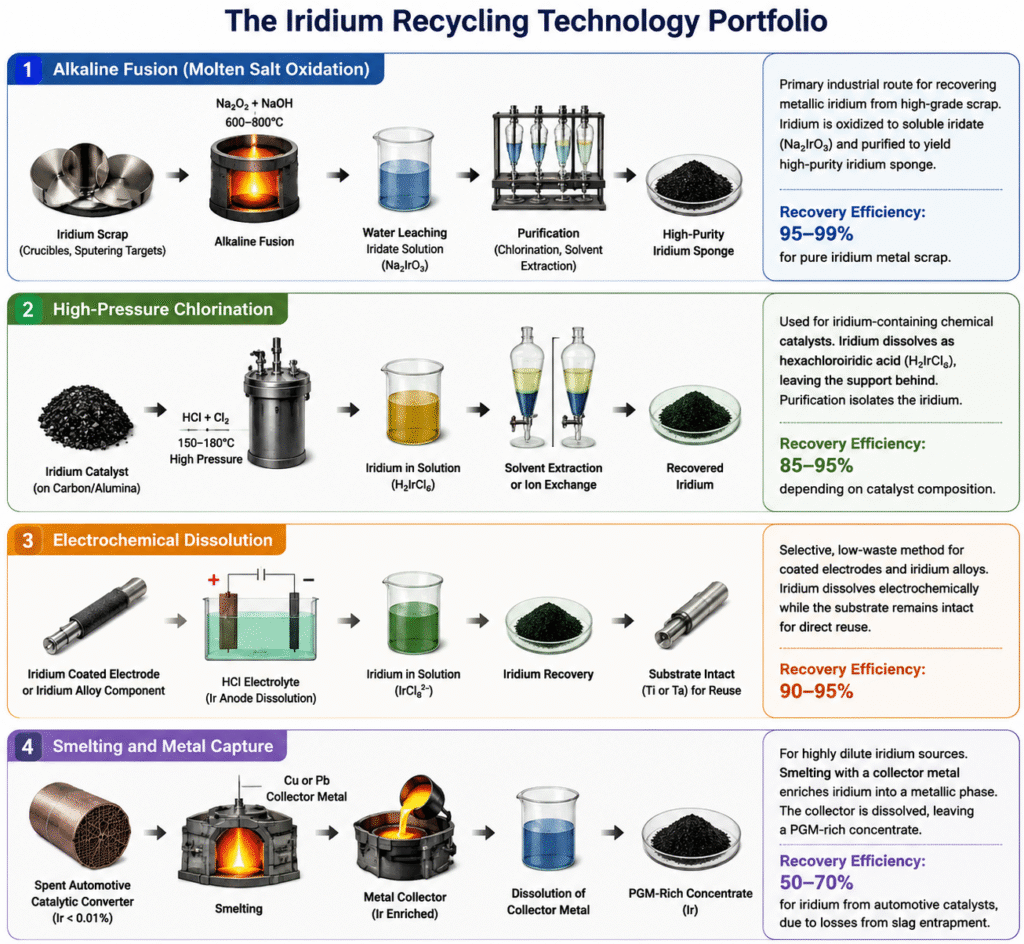
Alkaline Fusion (Molten Salt Oxidation)
This is the primary industrial route for recovering metallic iridium from high-grade scrap such as used crucibles and sputtering targets. The process involves fusing the iridium scrap with sodium peroxide (Na₂O₂) and sodium hydroxide (NaOH) at 600-800°C. Under these strongly oxidizing conditions, iridium is converted into a water-soluble iridate (Na₂IrO₃). After water leaching, the iridium-bearing solution is purified through chlorination, solvent extraction, and precipitation, ultimately yielding high-purity iridium sponge.
- Recovery Efficiency: 95-99% for pure iridium metal scrap.
High-Pressure Chlorination
This hydrometallurgical method is tailored for iridium-containing chemical catalysts, typically supported on carbon or alumina. The spent catalyst is treated in a high-pressure autoclave with hydrochloric acid and chlorine gas at 150-180°C. Iridium dissolves as hexachloroiridic acid (H₂IrCl₆), leaving the insoluble support material behind. Solvent extraction or ion exchange then isolates the iridium.
- Recovery Efficiency: 85-95%, depending on catalyst composition.
Electrochemical Dissolution
For coated electrodes and iridium alloy components, electrochemical dissolution offers a highly selective, low-waste alternative. The scrap is used as the anode in a hydrochloric acid electrolyte. An applied current dissolves the iridium coating into solution while leaving the titanium or tantalum substrate intact, allowing the substrate to be directly reused. The iridium is subsequently recovered from the electrolyte.
- Recovery Efficiency: 90-95%.
Smelting and Metal Capture
For highly dilute iridium sources, such as spent automotive catalytic converters (Ir <0.01%), pyrometallurgical enrichment is the only economically viable first step. The ceramic monolith is smelted with a copper or lead collector metal. The molten collector extracts the iridium into a metallic phase, which is separated from the slag. The collector metal is then dissolved chemically, leaving a PGM-rich concentrate for further refining.
- Recovery Efficiency: 50-70% for iridium from automotive catalysts, due to losses from slag entrapment.
2. Market Recovery Rates: A Segmented View
Iridium recovery rates are not uniform across all applications. The industry recognizes a significant disparity between high-grade and dispersed end-uses, as summarized below:
| Scrap Source | Typical Ir Grade | Primary Technology | Industry Average Recovery Rate |
| Iridium Crucibles / Targets | >90% | Alkaline Fusion | 95-99% |
| Chemical Catalysts | 0.1-5% | High-Pressure Chlorination | 85-95% |
| Electrode Coatings | 5-30% | Electrochemical Dissolution | 90-95% |
| Automotive Catalysts | <0.01% | Smelting / Metal Capture | 50-70% |
| Global End-of-Life Recycling Rate | — | — | ~30-40% |
The low overall EOL recycling rate of 30-40% is primarily attributable to the large volume of iridium dissipated in automotive catalysts, where recovery is technically challenging and economically borderline at current iridium price levels.
3. Economic Context
As of June 22, 2026, the domestic spot price of 99.95% purity iridium in China stands at approximately RMB 1,710–1,740 per gram. On the international market, the iridium spot price is approximately USD 7,400 per troy ounce.
For context, the same period sees platinum at approximately RMB 410–418 per gram (domestic) or USD 1,800 per ounce (international), and palladium at approximately RMB 299–303 per gram (domestic) or USD 1,370 per ounce (international).
It is worth noting that iridium prices experienced a significant correction to approximately USD 1,400 per ounce (around RMB 320 per gram) in May 2025, but have since rebounded strongly in 2026, surpassing previous historical highs. At the current price level of approximately RMB 1,720 per gram, recovering iridium from high-grade scrap using alkaline fusion or electrochemical methods is not only economically viable but highly profitable. For iridium crucible and target scrap, our clients benefit from a buy-back price structure that reflects over 90% of the contained metal value.
Conclusion
Recovering iridium is a testament to metallurgical ingenuity. By matching the right technology to each scrap type, we can achieve near-perfect circularity for high-grade residues while working to close the gap on dispersed applications. [Company Name] is your trusted partner in this endeavor, turning today’s iridium waste into tomorrow’s high-performance materials.
