
Closing the Loop: Advanced Tin Recycling Technologies for a Sustainable Electronics Supply Chain

Introduction
Tin, the essential bonding agent in electronics, underpins the functionality of every circuit board, semiconductor, and connector. With nearly 50% of global tin consumption directed to solder production, the end-of-life electronics stream represents a rich “urban mine” of this strategic metal. However, the complexity of tin-bearing wastes—ranging from high-grade solder dross to low-grade tinplate scrap—demands a sophisticated portfolio of recycling technologies. At [Company Name], we are at the forefront of developing and implementing advanced, integrated solutions for tin recovery, driving circularity from waste back to high-purity metal and alloy.
1. The Tin Recycling Technology Matrix
Our approach is built on a mastery of four core metallurgical pathways, each tailored to specific input feedstocks:
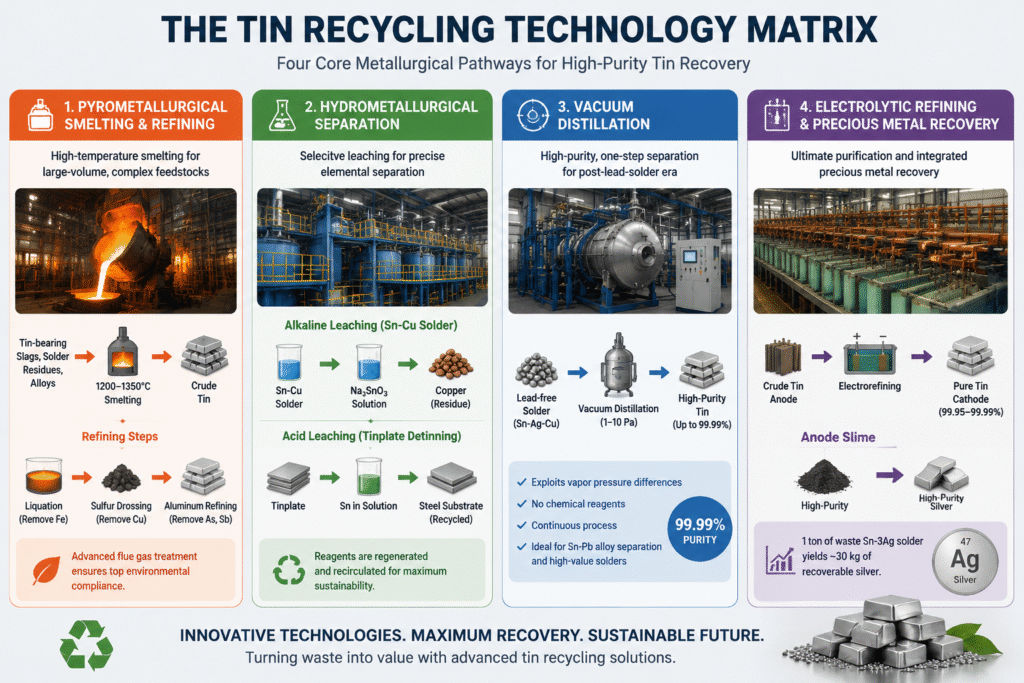
- Pyrometallurgical Smelting and Refining: Serving as the industrial workhorse, this route processes large volumes of tin-bearing slags, solder residues, and complex alloys. In high-temperature furnaces (1200-1350°C), tin oxides are carbothermically reduced to crude tin, which is subsequently purified through a sequence of fire-refining steps—liquation for iron removal, sulfur drossing for copper, and aluminum refining for arsenic and antimony. Our smelting operations are equipped with advanced flue gas treatment systems to ensure compliance with the strictest environmental standards.
- Hydrometallurgical Separation: For materials requiring precise elemental separation, our alkaline and acidic leaching circuits offer unparalleled selectivity. By leveraging tin’s amphoteric nature, our alkaline leaching process dissolves tin from copper-bearing scrap (e.g., Sn-Cu solder) into solution as sodium stannate, leaving copper as an insoluble residue. The tin is then recovered as high-purity cathode metal via electrowinning, with the process alkali regenerated and recirculated. For tinplate detinning, our acid-based systems selectively remove the tin layer while preserving the steel substrate for separate recycling.
- Vacuum Distillation: This is our high-purity workhorse for the post-lead-solder era. Operating under precisely controlled vacuum (1-10 Pa) and temperature conditions, our continuous vacuum distillation furnaces exploit the substantial vapor pressure differences between tin and impurity elements like lead and bismuth. The result is a one-step, reagent-free separation that produces tin with a purity of up to 99.99%. This technology is the definitive solution for reclaiming high-value lead-free solders (such as Sn-Ag-Cu) and for separating tin-lead alloys into their pure constituent metals.
- Electrolytic Refining and Precious Metal Recovery: As the ultimate purification step and an integrated precious metal recovery hub, our electrorefining cells produce 99.95-99.99% pure tin cathodes from crude tin anodes. Crucially, valuable metals like silver, which are more noble than tin, are not dissolved and instead report to the anode slime. From this slime, we recover high-purity silver, a significant value driver when processing silver-bearing solder scrap. For instance, one metric ton of waste Sn-3Ag solder can yield approximately 30 kg of recoverable silver.
2. Economic Drivers: Market Signals and Value Recovery
The economic viability of advanced tin recycling is reinforced by the prevailing market structure. As of June 15, 2026, the spot prices on the Shanghai Metals Market (SMM) stand at:
- Tin Ingot (99.9%): 424,550 RMB(approximately 62,353 USD)/metric ton
- Lead Ingot (99.994%): 16,100 RMB(approximately 2,365 USD)/metric ton
- Silver (99.99%): 16,861 RMB(approximately 2493.74 USD)/kg
The tin-to-lead price ratio of over 26:1 fundamentally alters the process economics. Simple smelting of mixed Sn-Pb scrap produces a low-value alloy, whereas our vacuum distillation technology cleanly separates the two metals, maximizing the recovered value of the tin. Furthermore, the simultaneous recovery of silver from solder scrap transforms our electrorefining circuit from a cost center into a significant profit contributor.
3. Global Supply and the Circular Imperative
According to the International Tin Association (ITA), the global end-of-life recycling rate for tin currently stands at only 30-35%. This represents a massive, addressable resource gap. China, as both the world‘s largest tin consumer and a major generator of electronic waste, holds the key to unlocking this potential. Our company is actively working to bridge this gap by deploying integrated recycling hubs that combine intelligent sorting, advanced metallurgy, and direct re-alloying capabilities for a true closed-loop solder cycle.
Conclusion
Tin recycling is no longer a peripheral environmental exercise; it is a core strategic competency for a resource-constrained world. By integrating pyrometallurgical robustness, hydrometallurgical selectivity, vacuum metallurgy precision, and electrolytic refining depth, [Company Name] delivers a complete technology suite that transforms end-of-life products into a reliable, high-quality, domestic supply of tin. We invite partners across the electronics value chain to join us in building a truly circular tin economy.
