

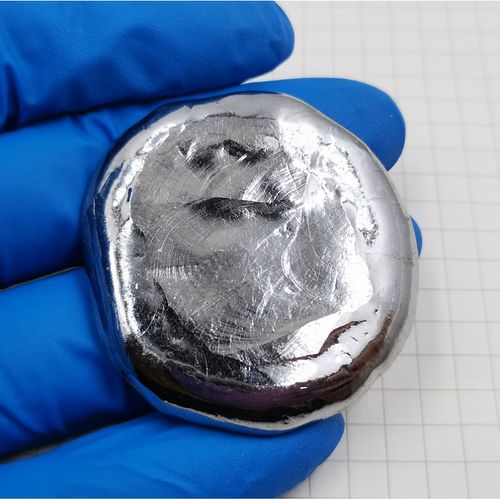
Rhenium Alloys: Cutting-Edge High-Temperature Materials Challenging the 1500°C Limit

Metallic rhenium, with its melting point of 3180°C, stands as the last naturally occurring stable element to be discovered and an irreplaceable strategic material for cutting-edge fields such as aerospace and nuclear energy.
I. The Metal King Breaking Through High-Temperature Limits
As aero-engine turbine temperatures approach 1600°C and rocket combustion chambers endure thermal shocks exceeding 3000°C, conventional superalloys have reached their performance limits. At this juncture, nickel-based single-crystal alloys containing 5%-6% rhenium become the only solution—this mysterious metal elevates the operating temperature of superalloys by 200-300°C and enhances thermal strength by over 30%.
Core Performance Data
| Performance Indicator | Rhenium Alloy (6% Re) | Conventional Ni-Based Alloy | Improvement |
|---|---|---|---|
| Melting Point (°C) | ~1400-1500 | 1100-1300 | +200°C |
| High-Temp Creep Strength (1000°C) | 450 MPa | 300 MPa | +50% |
| Recrystallization Temperature (°C) | >1500 | 1200 | +300°C |
| High-Temperature Oxidation Rate | Reduced by 40% | Baseline | Significant Improvement |
II. Four Pillars of High-Temperature Performance
1. Atomic Bonding Energy Barrier
Rhenium’s electron shell structure (5d⁵6s²) forms high-strength metallic bonds with a binding energy reaching 837 kJ/mol, nearly double that of nickel (430 kJ/mol). At 1500°C, atomic vibration amplitude increases by only 12% (compared to 25% for conventional alloys), fundamentally inhibiting lattice distortion.
2. Dynamic Strengthening Mechanism
In high-temperature environments, the diffusion rate of rhenium atoms within the nickel matrix is two orders of magnitude lower than that of tungsten. When temperatures exceed 1300°C, rhenium atoms form nanoscale Re-W composite precipitate phases (approximately 2-5 nm in size) at grain boundaries. Through pinning effects, these phases elevate the grain boundary migration energy barrier to 5.2 eV, three times higher than the pure nickel matrix.
3. Environmental Erosion Resistance
In the oxygen-rich combustion environment of aero-engines, rhenium alloys develop a dual-layer oxide film structure on their surface:
- Outer layer: Dense Cr₂O₃ film (thickness 1-2 μm)
- Inner layer: ReO₂ + Al₂O₃ composite film (thickness <0.5 μm)
At 1500°C, the oxidation rate is only 0.12 mg/cm²·h, a 65% reduction compared to conventional alloys, successfully resisting combustion gas corrosion.
4. Plastic Deformation Control
Rhenium’s stacking fault energy (320 mJ/m²) is significantly higher than nickel’s (240 mJ/m²), promoting dislocation cross-slip at high temperatures. Under 1500°C/100 MPa stress, the steady-state creep rate decreases to 1.2×10⁻⁸ s⁻¹, enabling turbine blade lifetimes to突破 the 5000-hour milestone.
III. Irreplaceability in Cutting-Edge Fields
1. Aero-Engine Revolution
Pratt & Whitney’s PW1000G engine utilizes third-generation rhenium-nickel alloy (containing 6% Re), achieving turbine inlet temperatures of 1650°C and a thrust-to-weight ratio exceeding 12:1. GE Aviation’s GE9X engine sets a record with 15 grams of rhenium per single-crystal blade in its high-pressure turbine, contributing to a 15% fuel consumption reduction.
2. Space Propulsion Systems
The combustion chamber of Russia’s RD-180 rocket engine employs molybdenum-rhenium alloy (Mo-47Re), withstanding thermal shocks up to 3371°C while maintaining structural integrity with cooling channels only 0.8 mm thick. SpaceX’s Raptor engine pre-burner injectors similarly utilize rhenium-copper composites to endure 3000°C oxygen-rich combustion gases.
3. Nuclear Energy Critical Components
In Generation IV nuclear reactors, rhenium alloys serve as control rod guide tube materials, maintaining functional integrity under accident conditions reaching 1600°C. The International Thermonuclear Experimental Reactor (ITER) utilizes tungsten-rhenium alloy (W-5Re) for divertor components,withstand heat loads of 20 MW/m².
IV. Technical Bottlenecks and Development Trends
Current Challenges
- Cost Dilemma: Rhenium prices have long remained at $3000-5000/kg, accounting for over 60% of alloy manufacturing costs.
- Processing Difficulty: Casting yield rates are below 40%, and directional solidification requires temperatures up to 1750°C.
- Resource Constraints: Global annual production is only 60 tonnes, with 70% concentrated as a by-product of Chilean copper mines.
Innovation Directions
- 3D Printing Technology: Siemens utilizes laser powder bed fusion technology, reducing rhenium component manufacturing cycles by 80% and increasing material utilization from 15% to 85%.
- Gradient Composite Materials: NASA is developing nickel/rhenium functionally graded materials to achieve smooth stress transitions across 1500°C temperature gradient interfaces.
- Recycling Technology Breakthroughs: Mitsubishi Heavy Industries has established a rhenium回收 system achieving recovery rates exceeding 90% from spent turbine blades.
V. Strategic Value and Future Outlook
As sixth-generation aero-engine target temperatures approach 1800°C, the development of fourth-generation single-crystal alloys containing over 10% rhenium has entered the engineering validation phase. Within the EU’s Clean Sky program, rhenium-alloy high-pressure turbine blades are designated as the highest priority material (TRL6). Meanwhile, China’s “New Material Industry Development Guidelines” categorizes high-purity rhenium materials as “frontier new materials,” with annual demand growth reaching 20%.
As human power systems relentlessly approach thermodynamic limits, rhenium alloys stand like an “anchor in the storm” of the high-temperature world. Amidst the 1500°C inferno, this rare metal, constituting merely one part per billion of the Earth’s crust, underpins humanity’s driving ambition for breakthroughs into higher dimensions.
