

Platinum Group Metals Performance Comparison: Osmium’s Unique Position

The platinum group metals (PGMs)—platinum (Pt), palladium (Pd), rhodium (Rh), iridium (Ir), osmium (Os), and ruthenium (Ru)—are six transition metals in Group VIII of the periodic table. With an extremely low crustal abundance (approximately 0.001 ppm total PGE content) and exceptional physicochemical properties, they have become the “critical cornerstone” of modern industry.
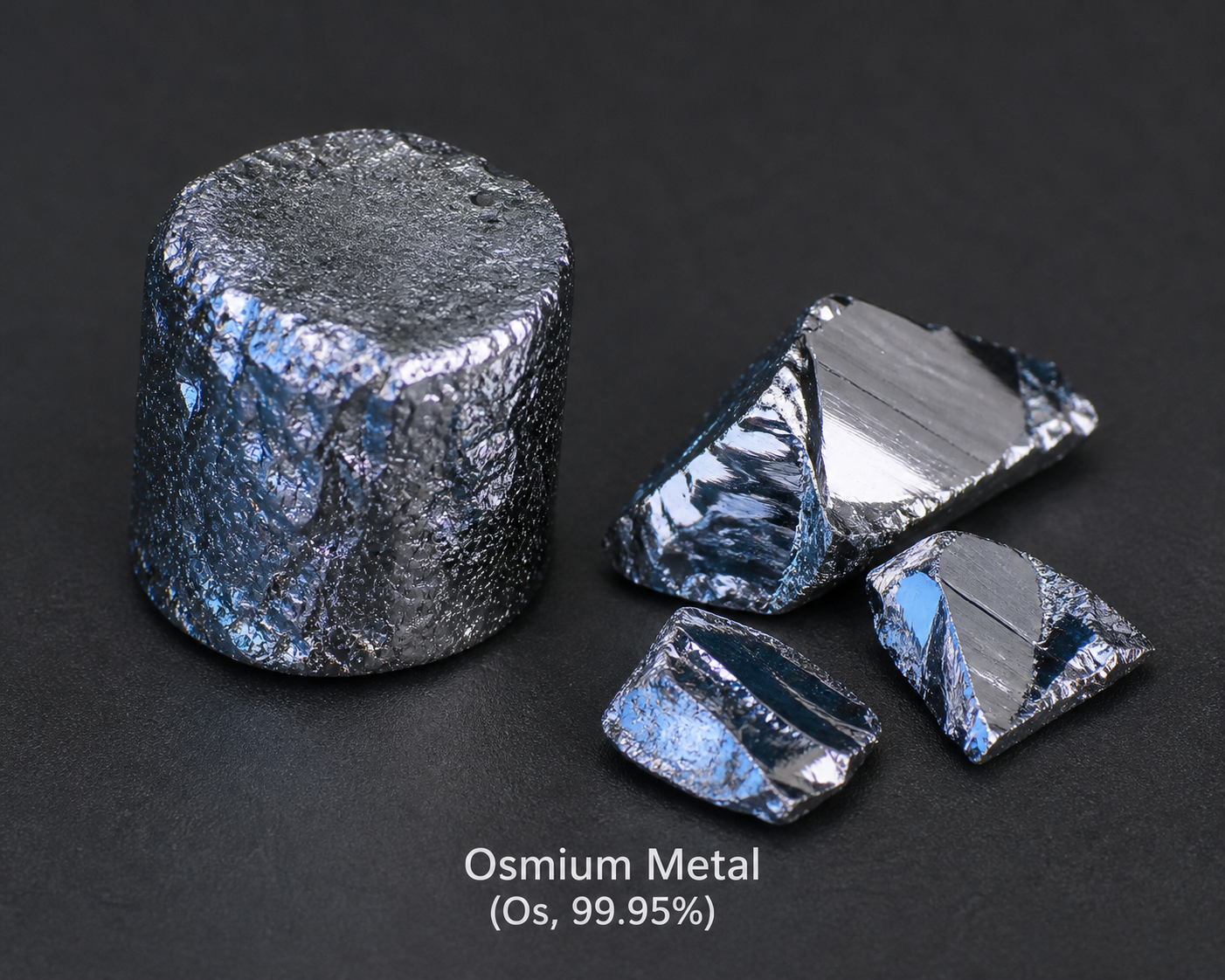
Among the PGMs, osmium stands out as the most distinctive—it is the densest naturally occurring element and one of the hardest metals, yet it is brittle, difficult to process, and its oxide is highly toxic. This “extreme yet contradictory” nature gives osmium a unique position within the PGM family.
I. Physical Properties: Density, Melting Point, and Crystal Structure
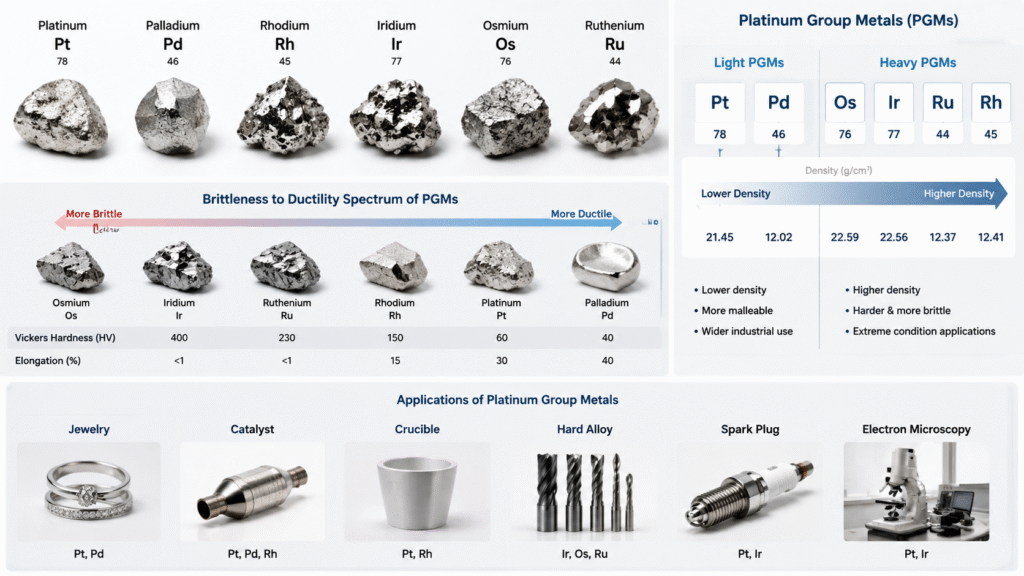
PGMs exhibit a clear “light-heavy” differentiation pattern:
| Metal | Density (g/cm³) | Melting Point (°C) | Crystal Structure | Color |
| Osmium | 22.59 | 3045 | Hexagonal close-packed | Bluish-gray |
| Iridium | 22.56 | 2446 | Face-centered cubic | Silver-white |
| Platinum | 21.45 | 1772 | Face-centered cubic | Silver-white |
| Ruthenium | 12.45 | 2334 | Hexagonal close-packed | Silver-gray |
| Rhodium | 12.5 | 1955 | Face-centered cubic | Silver-white |
| Palladium | 12.02 | 1555 | Face-centered cubic | Silver-white- |
Density: Osmium ranks first among all elements at 22.59 g/cm³-, followed closely by iridium at 22.56 g/cm³. Platinum (21.45 g/cm³) also belongs to the “heavy” group, while ruthenium, rhodium, and palladium have densities of only 12–12.5 g/cm³—approximately half that of osmium.
Melting Point: Osmium’s melting point of 3045°C is the highest among PGMs. Iridium melts at 2446°C-, ruthenium at 2334°C-, rhodium at 1955°C, platinum at 1772°C-, and palladium at 1555°C.
II. Mechanical Properties: Hardness, Ductility, and Workability
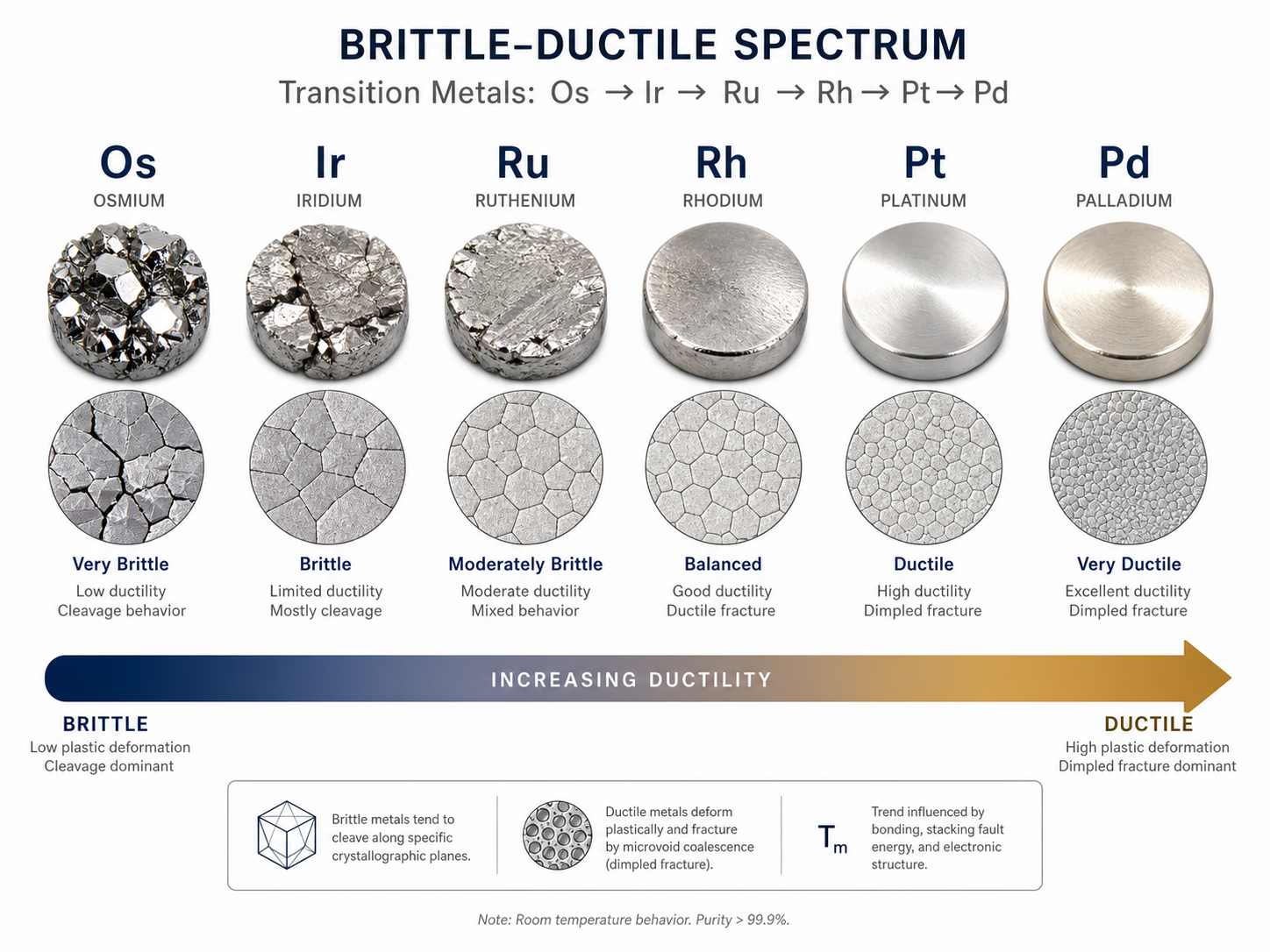
PGMs display a “soft-hard” polarization:
Osmium: Extremely hard but extremely brittle. It is one of the hardest metals-, yet hard and brittle with no plasticity and poor workability. It can be easily crushed into powder in an iron mortar. This “high hardness but high brittleness” paradox severely limits its applications.
Iridium: Hard and brittle, but workable at high temperatures. Mohs hardness ~6.5. It can be rolled into foil or drawn into wire at elevated temperatures.
Ruthenium: Hard, brittle, and highly wear-resistant. It serves as an effective hardener for platinum and palladium.
Platinum and Palladium: Excellent ductility. Platinum can be rolled into foil as thin as 0.1 microns; 1 gram can be drawn into a 1.6 km wire.
III. Chemical Properties: Corrosion Resistance, Oxidation, and Catalysis
Corrosion Resistance: PGMs generally exhibit excellent chemical stability. Iridium is the most corrosion-resistant metal—resistant to almost all acids at room temperature, including aqua regia. Platinum is extremely stable but dissolves in aqua regia. Palladium is the only PGM soluble in concentrated nitric acid.
Oxidation—Osmium’s Critical Weakness: At high temperatures, osmium readily forms volatile osmium tetroxide (OsO₄) , which is highly toxic. Despite its toxicity, OsO₄ is used as a staining agent in electron microscopy due to its unique affinity for lipids.
Catalytic Activity: PGMs have outstanding catalytic properties. Palladium has strong hydrogen absorption capacity; platinum is a core catalyst material; ruthenium is an excellent catalyst for hydrogenation, isomerization, oxidation, and reforming. Osmium has the lowest catalytic activity among PGMs.
IV. Applications: Performance Dictates Use
| Metal | Core Applications | Performance Basis |
| Osmium | Wear-resistant alloys, electron microscopy staining, alloy additives | Highest density, extreme hardness, OsO₄ staining |
| Iridium | Crucibles, spark plug electrodes, thermocouples, pen nibs, optoelectronics | Extreme corrosion resistance, high melting point |
| Platinum | Jewelry, catalysts, medical devices, thermocouples | Ductility, chemical stability, catalytic activity |
| Ruthenium | Hard alloys, electrical contacts, catalysts, PGM hardener | Hardness, wear resistance, catalysis |
| Rhodium | Auto catalysts, electroplating | Catalytic activity, corrosion resistance |
| Palladium | Catalysts, jewelry, electronics | Ductility, hydrogen absorption, catalysis |
V. Market Prices (August 2026)
The PGM market has seen stark divergence in 2026—all varieties face tight supply-demand deficits, yet price trends are completely divergent:
| Metal | Price (Aug 2026) | Market Trend |
| Iridium | ~RMB 2,060/g | Best-performing PGM in 2026, up >70% YTD |
| Rhodium | ~RMB 2,045/g | High level, supported by auto catalysts |
| Ruthenium | ~RMB 420/g | Driven by green hydrogen & semiconductors |
| Platinum | ~RMB 410/g | Volatile, sharply down from 2026 peak of RMB 739/g |
| Palladium | ~RMB 305–317/g | Relatively loose supply-demand balance |
| Osmium | ~RMB 136/g | Niche market, limited trading |
