

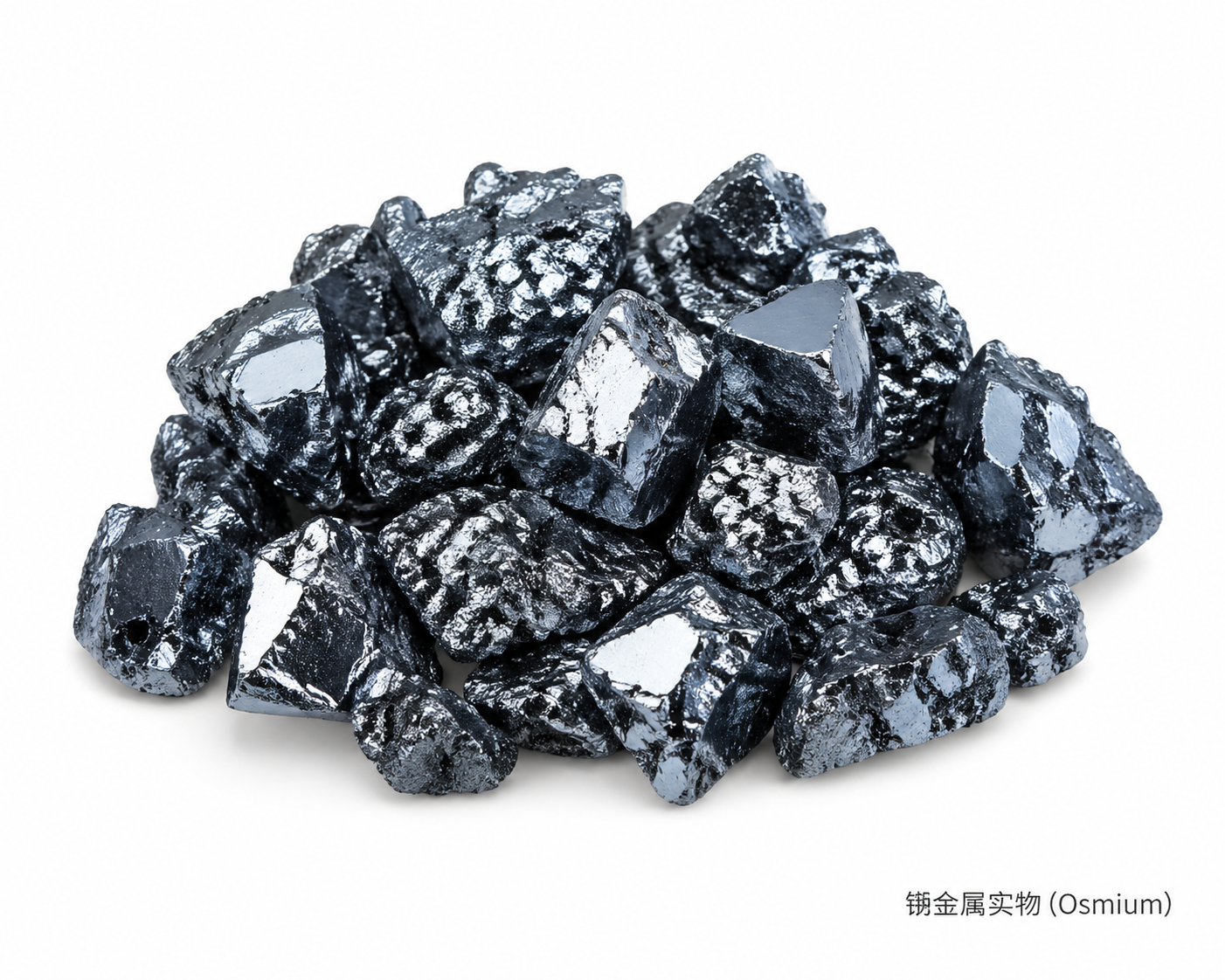
Osmium in High-End Manufacturing: From Extreme Material Properties to Hydrogen Energy Applications

Abstract:
Osmium, one of the rarest and most physically extreme members of the platinum group metals, is commanding increasing attention from high-end manufacturing sectors globally. This white paper provides a comprehensive analysis of osmium‘s unique material properties, current and emerging industrial applications, recent breakthroughs in catalysis (particularly in hydrogen evolution reaction), and an overview of global supply dynamics. With a density of 22.57 g/cm³, a melting point of 3045°C, and annual global production of merely ~2 tonnes, osmium represents a critical intersection of extreme material performance and extreme supply scarcity.
Date: April 2026
Keywords: Osmium; Platinum Group Metals; Catalysis; Hydrogen Evolution Reaction; Wear-Resistant Alloys; Sputtering Targets
Category: Industry Research / Technology White Paper
1. Introduction
Osmium (Os), element 76 in the periodic table, is a heavy platinum group metal originally discovered in 1803 by English chemist Smithson Tennant. Its name derives from the Greek ”osme“ (odor), referencing the pungent smell of its volatile tetroxide compound. Despite being among the least known precious metals, osmium’s unique combination of physical properties—including the highest density among all elements and extreme hardness—makes it irreplaceable in multiple high-end manufacturing niches. With recent breakthroughs in hydrogen evolution catalysis and semiconductor applications, osmium is entering a new phase of strategic significance.
2. Physical and Chemical Properties
Osmium‘s exceptional properties form the foundation of its industrial value:
| Property | Value | Source |
| Density | 22.57 g/cm³ (20°C) | [7] |
| Melting Point | 3045°C | [7] |
| Boiling Point | 5012°C | [7] |
| Hardness | HV ~800 MPa | [27] |
| Crystal Structure | Hexagonal close-packed (HCP) | [7] |
| Electrical Resistivity | 8.12 × 10⁻⁸ Ω·m (20°C) | [7] |
| Oxidation States | -2 to +8 (11 distinct states) | [9] |
Osmium exhibits high chemical inertness—it is stable in air, halogens, water, and non-oxidizing acids, and only slightly soluble in nitric acid and aqua regia. However, powdered osmium readily oxidizes to form osmium tetroxide (OsO₄), a volatile, highly toxic compound with a characteristic pungent odor.
3. Core Application Domains
3.1 Hard Alloys and Wear-Resistant Components
The most established application of osmium is in osmium-iridium alloys, which are employed in fountain pen nibs, ballpoint pen tips, precision instrument bearings, and clock mechanisms. These alloys offer exceptional resistance to frequent mechanical wear and can outlast the instruments they serve.
Industrial-grade osmium alloys with tungsten or molybdenum are used as arc lamp filaments, ensuring stable luminescence at high temperatures. Osmium-platinum alloys are fabricated into ultra-hard surgical blades that combine sharpness with corrosion resistance.
3.2 Aerospace and Defense
Osmium alloys are used in the production of jet engine components and rocket nozzles, leveraging their ability to maintain structural integrity under extreme thermal and mechanical stress. In defense, osmium alloys contribute to armor coatings for tanks and launch systems for anti-tank and anti-aircraft missiles, where toughness and battlefield durability are paramount.
3.3 Electronics and Semiconductor Manufacturing
Osmium has found a growing role in the electronics industry, particularly in high-purity sputtering targets for physical vapor deposition (PVD). These targets are used to deposit thin films onto semiconductor substrates. Osmium-based electrical contacts, valued for their high conductivity, low contact resistance, and excellent wear resistance, are increasingly employed in miniaturized electronic devices.
Market research identifies osmium-based material expansion in semiconductor manufacturing as a key demand growth driver for osmium powder over the next five years.
3.4 Biomedical Applications
- Electron Microscopy: A 1% osmium tetroxide aqueous solution is a standard staining agent for biological tissue specimens, reacting with lipids to deposit elemental osmium and enhance image contrast. It is also utilized in forensic fingerprint detection.
- Medical Implants: Osmium alloys are used in dental implants, surgical instruments, and pacemaker lead wires, valued for their biocompatibility and corrosion resistance.
- Radiogenic Isotope Geochemistry: The rhenium-osmium isotopic system functions as a core tool for studying mantle evolution, ore deposit genesis, and geochronology.
3.5 Organic Synthesis Catalysis
Osmium tetroxide serves as the premier oxidizing agent for the cis-dihydroxylation of alkenes—a critical transformation in pharmaceutical synthesis. American chemist K. Barry Sharpless was awarded the Nobel Prize in Chemistry (2001) for his pioneering work on osmium-catalyzed asymmetric dihydroxylation, and received a second Nobel Prize in 2022 for click chemistry. Osmium catalysts continue to be applied in asymmetric hydrogenation, asymmetric oxidation, and the synthesis of bioactive molecules including anticancer drug candidates.
3.6 Jewelry and Luxury Goods
Osmium’s distinctive blue-gray metallic luster and extreme rarity have attracted attention in the high-end jewelry market. When alloyed with gold, osmium produces a unique ”smoky gray“ tone. Some luxury brands are emphasizing the exclusivity of osmium-based products in their marketing strategies, with investors increasingly viewing the metal as a potential store of value.
4. Breakthroughs in Hydrogen Evolution Catalysis (2025)
4.1 Single-Atom Os Catalyst (Nankai University / PNAS)
In December 2025, Professor Zhou Qixing’s team at Nankai University reported an Os-SA@SNC catalyst: sulfur-doped carbon matrix converts osmium nanocrystals into atomically dispersed single-atom catalysts. Performance metrics: overpotential of only 13 mV at 10 mA/cm² in alkaline HER (vs. 19 mV for commercial Pt/C); Tafel slope of 38 mV/dec; negligible degradation after 30,000 CV cycles; 100 mA/cm² achieved at merely 115 mV overpotential (vs. 232 mV for Pt/C).
4.2 Boron-Interstitial Os Catalyst (QDU/KUST / Angew. Chem. Int. Ed.)
August 2025: a team from Qingdao University of Science & Technology and Kunming University of Science & Technology synthesized a boron-interstitial osmium catalyst via 10-second microwave quasi-solid-state ”flash welding.“ Results: 7 mV overpotential at 10 mA/cm² in natural seawater; 400-hour continuous operation without degradation in an AEM electrolyzer with 81.9% energy efficiency; hydrogen production cost reduced to $0.81/GGE (below U.S. DOE target). The boron interstitials create a local acidic microenvironment, solving both chlorine corrosion and calcium/magnesium deposition challenges in seawater electrolysis.
4.3 Os-Substituted Photocatalyst (Tokyo University of Science / ACS Catalysis)
December 2025: Professor Kazuhiko Maeda’s team substituted ruthenium in conventional dye-sensitized photocatalysts with osmium, enabling absorption of long-wavelength visible light (600-800 nm). Solar hydrogen production efficiency doubled compared to traditional ruthenium-based systems.
5. Global Supply and Market Dynamics
5.1 Supply-Demand Overview
- Annual global production: ~500 kg to 2 tonnes—approximately 1/5,000 to 1/15,000 of gold production
- Supply structure: Osmium has no independent economic deposits. All production is recovered as a by-product of platinum-group metals mining and nickel refining—supply elasticity is effectively zero.
- Geographic concentration: South Africa (~47%) and Russia (~47%) together account for ~94% of global osmium production. North America, Zimbabwe, and other regions contribute the remaining ~6%.
5.2 China‘s Resource Position
China’s explored platinum-group metal reserves total approximately 87.69 tonnes. However, a 2023 geological survey in Guangxi identified new PGM deposits with estimated reserves exceeding 200 tonnes (platinum equivalent), potentially improving China‘s strategic supply position.
5.3 Market Size and Pricing
The global osmium market was valued at approximately USD 119.32 million in 2024, projected to reach USD 142.41 million by 2032, growing at a CAGR of 2.5% (2025-2032). Key applications: catalysts, chemical manufacturing, electrical and electronics, and jewelry.
Pricing exhibits dramatic regional divergence:
- United States (Q3 2025): USD 2,562/gram
- Germany (Q3 2025): USD 2,194/gram
- United Kingdom (Q3 2025): USD 1,596/gram
- China (Feb 2026): ~90 RMB/gram (~USD 12.4/gram) for 99.9% purity
The vast China-international price gap reflects the highly opaque nature of osmium trade and fragmented regional markets.
6. Challenges and Outlook
Key Challenges:
- Extreme supply scarcity with zero independent production elasticity
- Mechanical processing difficulties due to ultra-high hardness
- Powder form toxicity risks (OsO₄) requiring stringent safety protocols
- Underdeveloped recycling infrastructure
Strategic Outlook:
Osmium is poised at a pivotal juncture. Hydrogen evolution catalysis represents the most significant new demand driver, with osmium demonstrating clear potential to displace platinum-group incumbents in electrochemical applications. Semiconductor manufacturing represents a secondary growth vector through sputtering target applications. While supply constraints will continue to limit total market size, osmium’s strategic value as an extreme-performance material in extreme-service environments is positioned for sustained upward appreciation.
