
Applications of Iridium in the Electronics Industry: From OLED Phosphorescence to Semiconductor Memory Electrodes

1. Introduction: Iridium’s Strategic Position
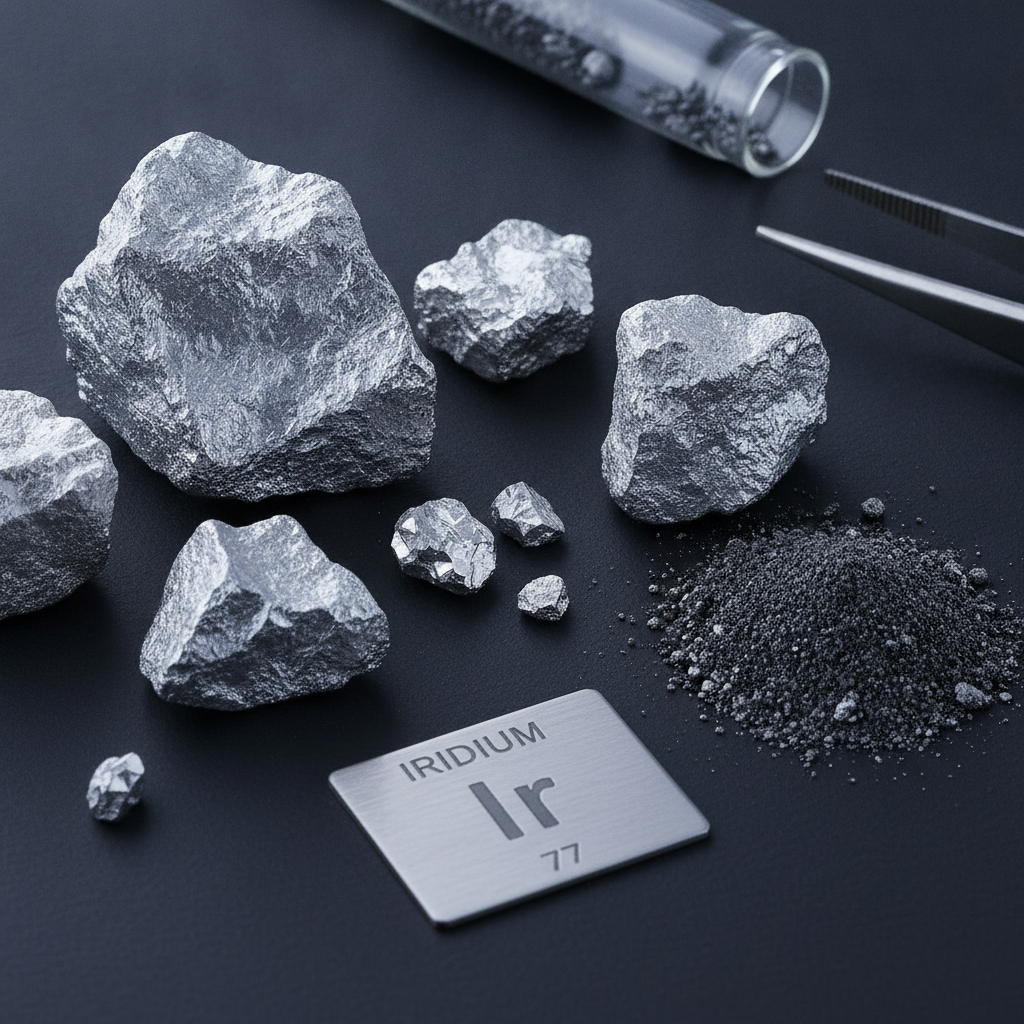
Iridium (Ir) stands as one of the rarest elements in the Earth’s crust, with an average abundance of approximately 0.001 ppm. According to USGS Mineral Commodity Summaries 2025, global primary iridium production—derived entirely as a by-product of platinum and palladium mining—typically ranges from approximately 7 to 8 tonnes per year. Global iridium mineral reserves are estimated at approximately 3,000 tonnes, with approximately 40% located in South Africa.
Iridium exhibits extreme physical properties: a melting point of 2,410–2,450°C, a boiling point of approximately 4,130°C, and a density of approximately 22.56 g/cm³, the highest of any known metal. Its exceptional corrosion resistance against virtually all acids, including aqua regia, combined with its high hardness (Mohs 6.5), positions iridium as a critical material in applications where extreme thermal and chemical stability are required.
2. OLED Displays: Iridium Complexes as Phosphorescent Emitters
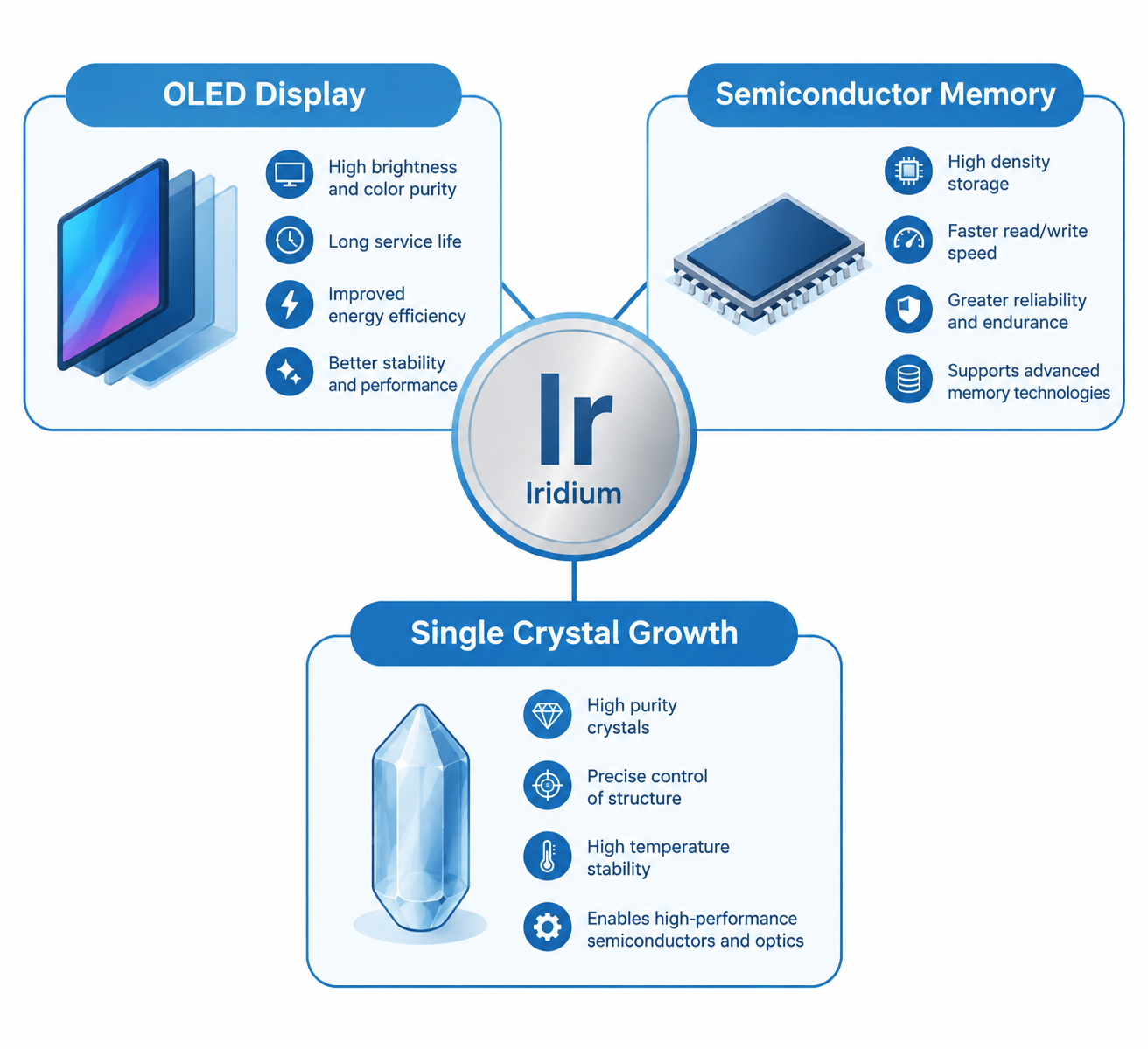
In OLED display technology, iridium is deployed as organometallic complexes (such as Ir(ppy)₃ and derivatives) that function as phosphorescent dopants within the emissive layer. The material system consists of:
- Host material: The organic host matrix (e.g., CBP) forming the emissive layer framework
- Transport layers: Hole transport, electron transport, and injection layer materials
- Functional component: Iridium complexes, typically doped at 5–10% concentration within the host
The critical mechanism is iridium’s strong spin-orbit coupling, which enables efficient radiative emission from triplet excitons, theoretically raising the internal quantum efficiency limit from 25% (fluorescent materials) to 100%. Recent research published in 2025 demonstrated [3+2+1] iridium(III) complexes achieving a maximum external quantum efficiency (EQE) of 15.4% in saturated red OLEDs, with photoluminescence quantum yields up to 98.1%. Another study on deep-red to near-infrared iridium complexes achieved 11.18% EQE in solution-processed OLEDs.
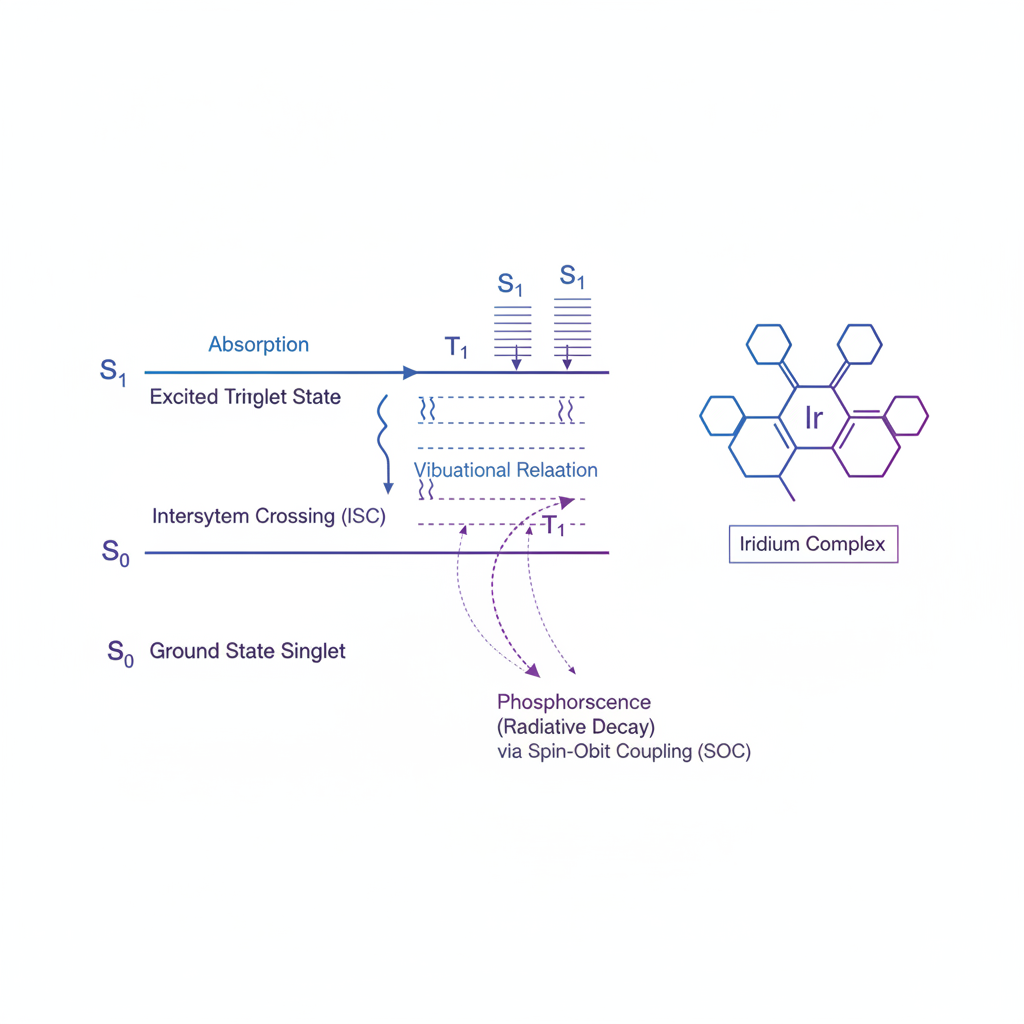
A critical distinction: iridium in these complexes exists as Ir(III) ions coordinated with organic ligands—its properties differ fundamentally from metallic iridium. While elemental iridium melts at 2,410–2,450°C, iridium organometallic complexes are molecular-scale luminescent materials without an independent melting point.
3. Semiconductor Memory: DRAM and FeRAM Capacitor Electrodes
In dynamic random-access memory (DRAM) and ferroelectric random-access memory (FeRAM), iridium and its oxide (IrO₂) serve as capacitor electrode materials. DRAM capacitor fabrication requires subsequent processing temperatures of up to 800°C, demanding electrode materials with high melting points, excellent conductivity, and chemical stability under oxidizing conditions.
In this application system:
- Primary substrate: Silicon-based CMOS transistor arrays forming the memory cell circuitry
- Functional layer: Iridium or iridium oxide thin films deposited by sputtering or PVD, serving as the capacitor bottom electrode
- Dielectric layer: High-permittivity materials (SBT, PZT, etc.) forming the storage capacitor in conjunction with the iridium electrode
Research has confirmed Ir-W alloy thin films as suitable DRAM and FeRAM capacitor electrode materials, with iridium electrodes demonstrating higher storage density than platinum. Ir/IrO₂ composite electrode structures have also been integrated with PZT ferroelectric capacitors to accommodate standard CMOS processing requirements.
4. Iridium Crucibles: Enabling Single-Crystal Growth
Iridium crucibles (99.9–99.95% purity) are essential for Czochralski and Bridgman single-crystal growth at operating temperatures of 2,100–2,200°C, without contaminating the melt. These crucibles support the production of:
- Lithium niobate (LiNbO₃) and lithium tantalate (LiTaO₃) : For surface acoustic wave (SAW) filters, core components in smartphone RF front-end modules
- YAG and GGG laser crystals: For solid-state lasers and optical communication pump sources
- Sapphire single crystals: For LED substrates and smartphone cover glass
Industry data from 2026 indicate that iridium crucibles for optical communication applications alone account for approximately one-quarter of relevant manufacturers’ processing volume, with demand growth driven primarily by optical communications, semiconductors, and laser industries.
5. Supply Chain and Recycling
Global iridium supply is highly concentrated, with South Africa accounting for approximately 85% of global production. China has demonstrated notable performance in iridium closed-loop recycling: the country’s iridium closed-loop recycling ratio reached 91.00% in 2025, reflecting successful direct industrial recirculation in the electrochemical sector. Global iridium recovery reached 2.42 tonnes in 2025, with China and North America contributing 0.83 and 0.62 tonnes respectively. Photocatalytic selective recovery of iridium from waste circuit boards represents an emerging recycling pathway.
6. Conclusion
Iridium’s role in the electronics industry is characterized by its function as a trace functional component rather than a bulk structural material. Whether as an organometallic phosphor in OLED displays, a thin-film electrode in semiconductor memory, or a crucible enabling single-crystal growth, iridium delivers indispensable performance at critical junctures. For electronics supply chain participants, iridium supply stability, processing capabilities, and closed-loop recycling efficiency represent core competitive factors.
