

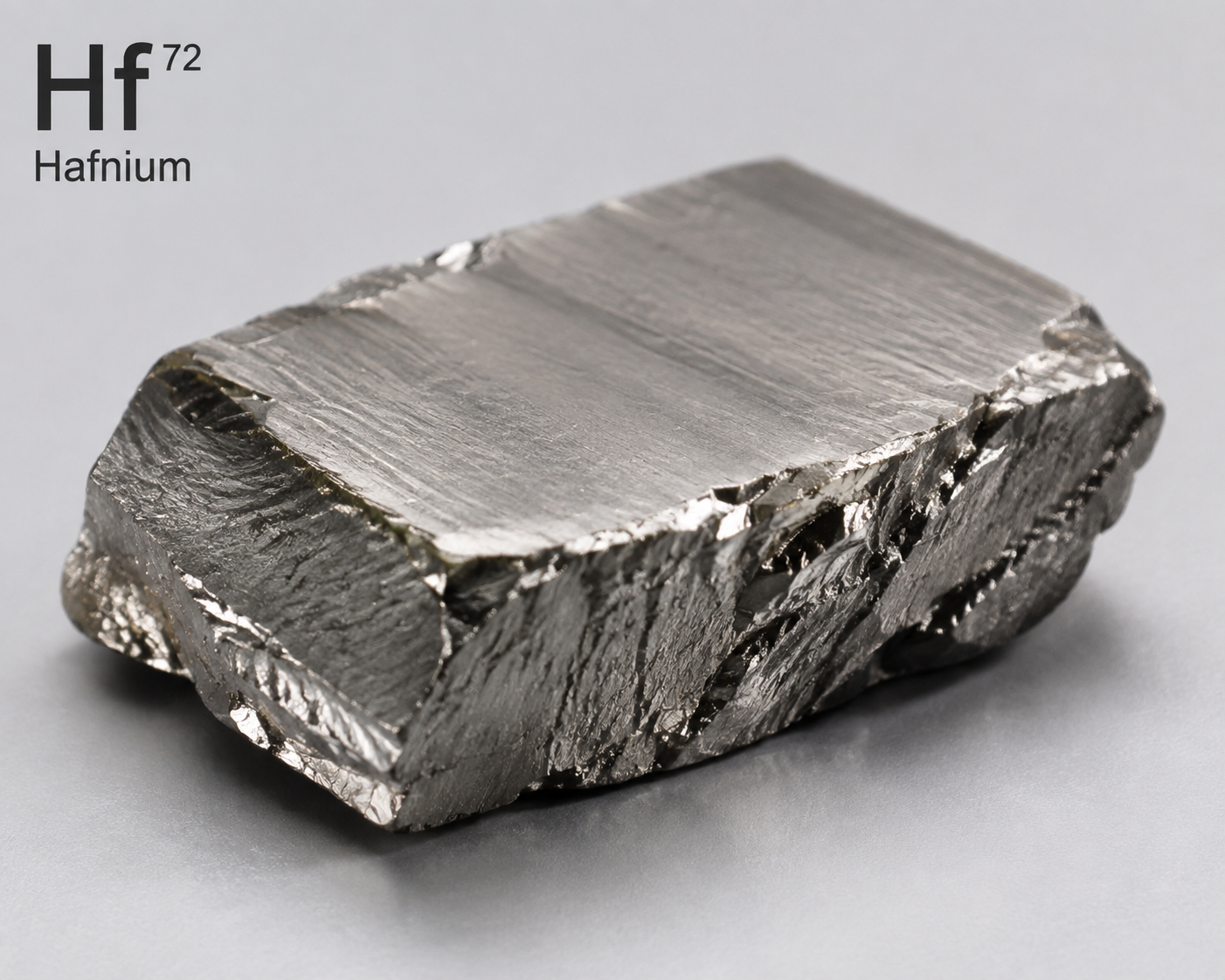
Hafnium Supply Chain Status and Market Price Trends

Hafnium (Hf), a rare refractory metal, has become strategically indispensable in nuclear industry, aerospace, and semiconductor manufacturing due to its exceptional neutron absorption capability, high-temperature stability, and high dielectric constant. From 2024 to 2026, driven by the AI computing boom, advanced semiconductor node scaling, and geopolitical tensions, hafnium has transformed from a niche metal into a globally recognized “strategic new darling,” with prices hitting record highs and supply chain dynamics undergoing profound restructuring.
I. Supply Chain Status: High Concentration and Structural Shortage
1. Global Resource Distribution and Production Capacity
Hafnium has no economically viable independent deposits and is almost entirely associated with zirconium in zircon minerals. Global zircon resources are primarily concentrated in Australia (~60%), South Africa (~20%), and Brazil (~10%) . China holds only ~500,000 tonnes of zircon reserves, less than 1% of global total, with over 90% import dependence.
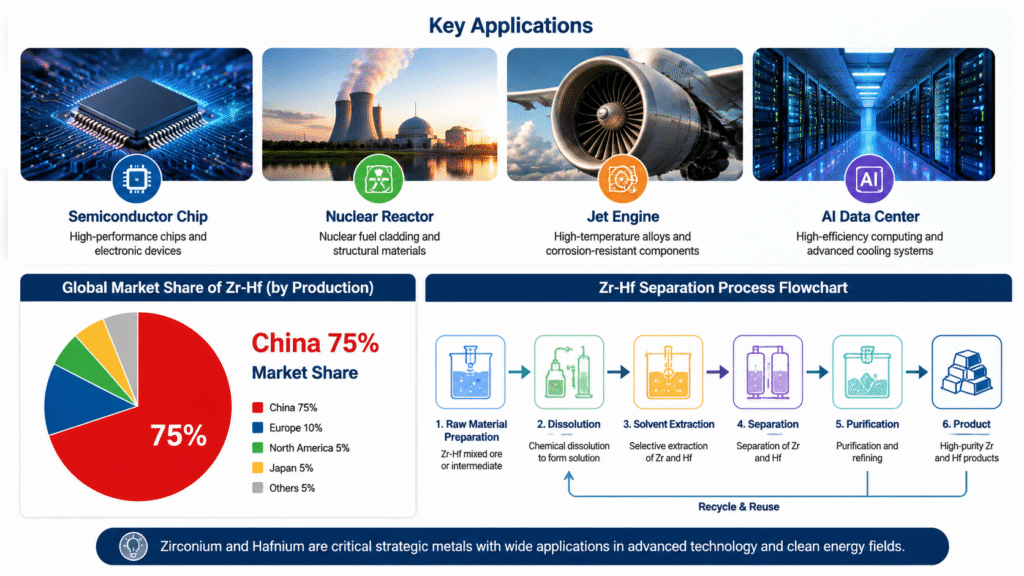
On the refining side, however, the picture is reversed—China controls approximately 75% of global hafnium production, with remaining supply from Russia, France, and the United States. Global annual hafnium production is estimated at only 70–75 tonnes, with a ~20-tonne annual supply gap for critical applications alone.
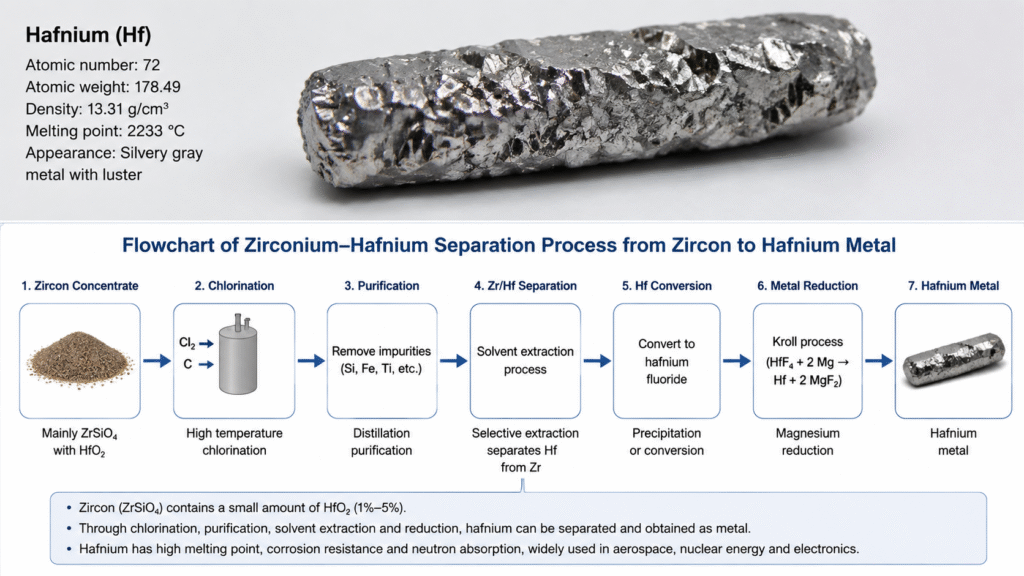
2. Supply Bottlenecks: Zirconium-Hafnium Separation
Hafnium’s scarcity stems from its chemical “twinning” with zirconium. Due to the lanthanide contraction, Zr⁴⁺ and Hf⁴⁺ ions have nearly identical radii and chemical properties, making zirconium-hafnium separation one of the most challenging hydrometallurgical processes. As hafnium is a byproduct of zirconium refining, traditional producers cannot significantly expand output without corresponding zirconium demand surges. Existing suppliers are unlikely to expand by more than 4% annually.
3. China’s Export Controls and Overseas Supply Gap
From H2 2025, China imposed export controls on hafnium to safeguard strategic resources. This policy directly cut off the primary supply source for overseas markets. Facing expected tightening, chipmakers and traders stockpiled, driving supply-demand imbalance and price spikes.
4. Recycling Technology Progress
Recycling offers a potential supply relief pathway. In 2025, Nantong Jingpeng filed a patent for a modular zirconium-hafnium separation device to improve recovery rates. Nanjing Youtian Metals filed a patent for waste slag resource utilization in calcium-thermal hafnium production. Processes for extracting Zr and Hf from tin slag can achieve 62% Zr and 75% Hf recovery, with oxidative leaching achieving 98% Zr and 99% Hf recovery. However, current hafnium recovery from e-waste remains below 10%.
II. Demand Structure: From Traditional to AI-Driven
1. Semiconductors — Largest Growth Driver
In sub-28nm logic chips, hafnium oxide (HfO₂) serves as a high-k gate dielectric, replacing traditional silicon dioxide (k=3.9) to “thicken” the gate insulator physically while maintaining electrical performance, solving leakage current issues in advanced nodes. High-k metal gate technology is now standard for 3nm and below.
2. Nuclear Industry — Irreplaceable Neutron Absorber
Hafnium effectively absorbs neutrons without swelling or becoming brittle in reactors, making it indispensable for nuclear reactor control rods.
3. Aerospace and Gas Turbines
Hafnium-based alloys are used in turbine blades, rocket nozzles, and spacecraft components, significantly enhancing nickel-based superalloy high-temperature performance.
4. AI Data Centers — New Demand Frontier
AI hardware expansion from chips to servers, networking, power, and cooling directly drives hafnium demand. Global hafnium demand is projected to grow from 100 tonnes in 2024 to 142 tonnes by 2030, with semiconductors contributing nearly half the increase.
III. Market Price Trends: Unprecedented Surge
Price Timeline:
| Period | Price | Change |
| 2022 | Domestic 4N HfO₂ ~RMB 4.5M/t | — |
| Early 2025 | Domestic industrial sponge Hf ~RMB 8,000/kg | — |
| Jan 2026 | Overseas Hf metal $11,556/kg | +164.76% vs early 2025 |
| Mar 2026 | Overseas Hf metal >$12,222/kg | +29% YTD |
| Apr 2026 | Overseas Hf metal $13,115/kg | +140%+ vs May 2025 |
| Aug 5, 2026 | Overseas Hf metal RMB 85M/t | +166.5% YoY |
Price Tiering:
- Industrial-grade HfO₂ (99%) : ~RMB 6,000/kg
- Electronic-grade HfO₂ (99.99%) : RMB 9,000–10,000/kg
- 99.99% high-purity Hf metal: $13–15M/tonne
- 98–99% purity unwrought Hf: ~$6M/tonne
IV. Outlook
Supply: Global production at 70–75 tonnes/year with a ~20-tonne annual deficit. Critical Metals Corp plans to add 120–150 tonnes/year via Greenland’s Tanbreez project, targeting China’s 75% market share—but commercial production remains years away.
Demand: Expected to grow nearly 70% by 2030, driven by AI data centers, advanced DRAM/HBM, and sub-3nm processes.
Price Outlook: Hafnium prices are expected to remain elevated in the near term, with domestic-international spreads likely widening further.
