

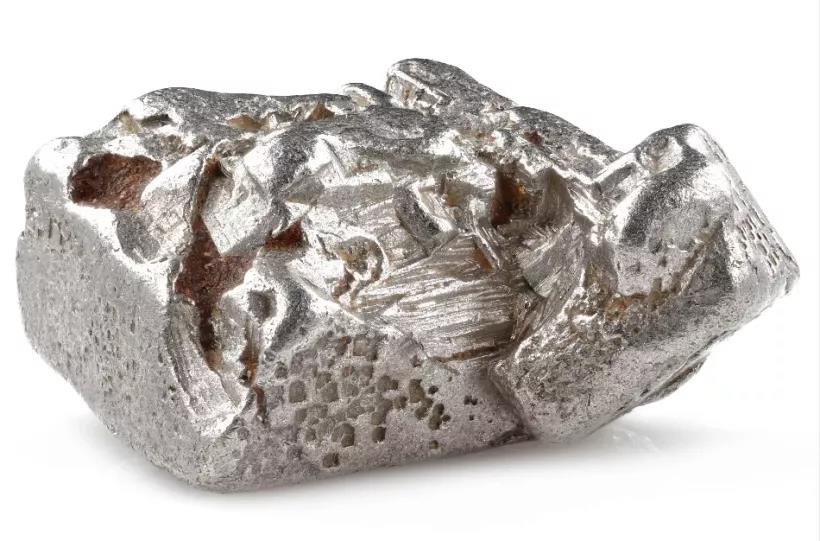
Rhodium: Physical Properties, Applications, and Technological Advances
Abstract
Rhodium (Rh), a critical member of the platinum group metals (PGMs), is an ideal material for extreme environments due to its high melting point (1964°C) and density (12.41 g/cm³). These properties stem from its face-centered cubic (FCC) crystal structure and strong metallic bonding derived from its 4d⁷5s¹ electron configuration. Rhodium is indispensable in automotive catalysts, high-temperature sensors, and corrosion-resistant electrodes, making precise determination of its physical parameters essential for industrial design. Breakthroughs in rhodium recovery technologies in China (e.g., >95% recovery from spent catalysts) have significantly enhanced supply chain stability.
1. Physical Properties and Theoretical Mechanisms
1.1 Melting Point Characteristics
- Measured data (IUPAC standard): 1964±1°C, significantly higher than platinum (1768°C) and palladium (1555°C).
- Theoretical basis:
- Strong metallic bonds (binding energy ~573 kJ/mol) due to incomplete 4d electron filling.
- High coordination number (12 nearest neighbors) in FCC structure enhances atomic packing.
1.2 Density Characteristics
- Measured value (25°C): 12.41 g/cm³, intermediate between ruthenium (12.45 g/cm³) and palladium (12.02 g/cm³).
- Structural influence:
- Atomic radius (134 pm) and FCC lattice parameter (a=3.80 Å) contribute to high density.
- XRD validation: Theoretical density error <0.3%.
2. Core Advantages in Extreme Environments
2.1 High-Temperature Performance
- Rhodium/Rh-10%Pt thermocouples: Operate stably at 1800°C (e.g., aircraft engine combustion chambers), with 10.5 mV/100°C thermoelectric output (Type S standard).
- Glass industry: Rhodium crucibles withstand 1600°C molten glass, offering 3× longer lifespan than zirconia alternatives.
2.2 Corrosion Resistance & Catalysis
- Rh-Pt gauze catalysts for nitric acid production: Achieve >98% ammonia oxidation conversion at 850°C/5 MPa; Rh enhances mechanical strength by 50%.
- Nuclear waste handling: 50 μm Rh coatings resist fluoride molten salt corrosion, with <0.1 mm/year corrosion rate.
3. Technical Challenges in Parameter Measurement
3.1 Melting Point Measurement
- Laser-heated levitation (LHL): Suspends samples in inert gas, enabling ±0.5°C precision via IR thermometry (eliminates container contamination).
- Differential scanning calorimetry (DSC): Requires Al₂O₃ crucibles; measures phase transition enthalpy (26.8 kJ/mol) at 20°C/min heating rate.
3.2 Density Measurement Standards
- Archimedes’ method: Uses anhydrous ethanol at 25±0.1°C, achieving <0.05% repeatability error.
- Synchrotron XRD: Calculates theoretical density from unit cell volume; <0.5% deviation validates purity.
4. Advances in Resource Recovery & Purification
4.1 China’s Recycling Innovations
- HCl-NaClO₃ leaching from spent auto-catalysts → ion exchange enrichment → H₂ reduction → 99.95% purity at 40% lower cost vs. primary mining.
- Electron beam melting (EBM): Refines crude Rh to 99.99% purity with <50 ppm oxygen, meeting semiconductor sputtering target requirements.
4.2 Global Supply Chain
- South Africa’s Bushveld Complex supplies 80% of global Rh.
- China’s secondary recovery now accounts for 15% of annual supply (2023: 2.3 tons recycled Rh).
Conclusion
Rhodium’s melting point and density are not only benchmark parameters but also dictate its performance limits in extreme environments. Advances in measurement precision (e.g., LHL) and recycling systems are unlocking new applications (e.g., PEM fuel cells, semiconductor packaging). Future priorities include:
- Nanoscale effects: 50 nm Rh particles exhibit ~200°C melting point depression.
- Biohydrometallurgy for low-grade ores, addressing 5% annual demand growth.
