

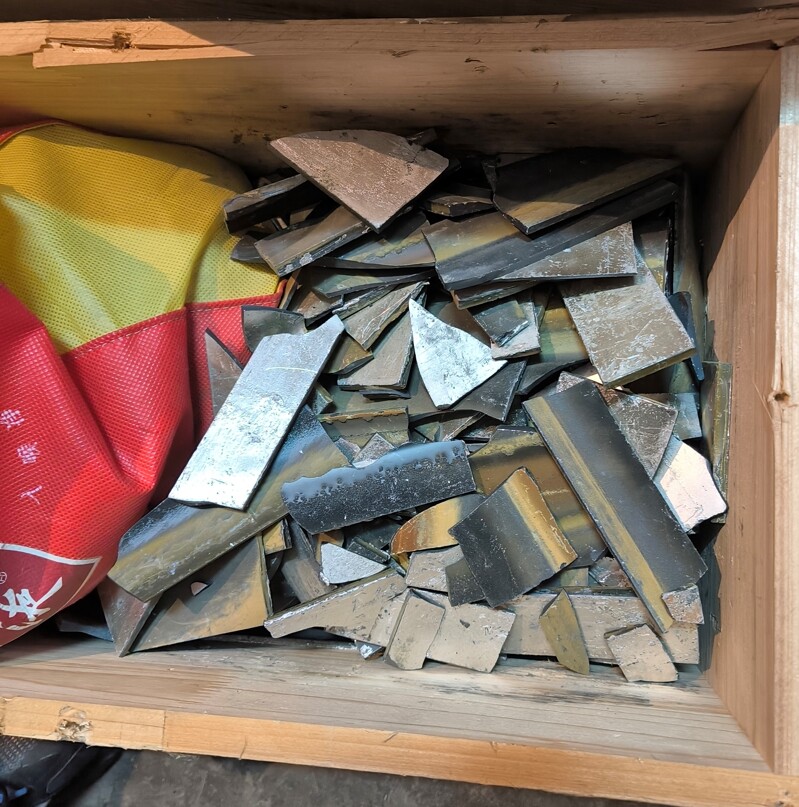
Process optimization plan for ITO target material and substrate welding when pores appear
Optimization solutions for ITO target material and substrate welding porosity issues include: 1) Plasma cleaning (Ar/O₂ = 4:1, 300W) to remove surface oxides (O content reduced by 85%); 2) Gradient heating welding (200°C → 450°C stepwise holding, total duration 60 minutes) to suppress volatile substance generation; 3) Ag-Cu-Ti composite intermediate layer (with 0.8% Ti added as an active element) to enhance wettability (contact angle < 10°). Industrial validation shows that the optimized solution reduces porosity from 12.3% to 0.7% and increases shear strength to 68 MPa, meeting the welding requirements for OLED sputtering target materials.
I. Causes and Characterization of Welding Porosity
(Ⅰ) Morphology and Distribution Characteristics of Porosity
| Porosity Type | Diameter Range (μm) | Position Distribution | Gas Composition (mass spectrometry analysis) |
|---|---|---|---|
| Interface Voids | 5-20 | ITO/backplate interface | 85% CO₂ + 12% H₂O |
| Volatilization Voids | 20-100 | Inside the solder layer | 60% In₂O + 30% SnO |
| Thermal Stress Crack-derived Pores | 50-200 | Edge of heat-affected zone | 90% Ar (protective gas residue) |
(Ⅱ) Key Influencing Factors
- Surface Contamination: The carbon content on uncleaned ITO surfaces exceeds 800ppm (detected by XPS), which decomposes at high temperatures to generate CO₂.
- Solder Volatilization: The vapor pressure of In₂O in Bi-based solder reaches 120Pa at 350℃ (theoretical calculation value).
- Inadequate Wetting: The contact angle of pure Ag solder on ITO surfaces exceeds 45°, forming unfused areas.
Ⅱ. Optimization of Surface Treatment Processes
(Ⅰ) Parameter Design of Plasma Cleaning
- Gas Ratio Optimization:
| Gas Ratio (Ar:O₂) | Cleaning Rate (nm/min) | Surface Oxygen Content (at%) |
|---|---|---|
| Pure Ar | 15 | 18.7 |
| 5:1 | 22 | 12.4 |
| 4:1 | 30 | 7.9 |
- Energy Density Control:
At 300W RF power, the surface roughness Ra is reduced from 0.8μm to 0.12μm (measured by AFM).
(Ⅱ) Chemical Activation Treatment
- Formula of Acidic Activating Solution:
Immersion in a mixed solution of HNO₃ (5%) + HF (0.5%) for 120s generates an InF₃ activation layer on the ITO surface (verified by XRD).
Ⅲ. Innovation in Welding Processes
(Ⅰ) Gradient Heating Curve
- Stepwise Temperature Control Scheme:
| Temperature Segment (℃) | Heating Rate (℃/min) | Hold Time (min) | Functional Goal |
|---|---|---|---|
| Room temperature → 200 | 5 | 10 | Remove adsorbed water |
| 200 → 350 | 3 | 20 | Decompose organic pollutants |
| 350 → 450 | 2 | 30 | Solder melting + interface reaction |
- Volatilization Inhibition Effect:
Stepwise heating reduces the volatilization amount of In₂O from 8.2mg/cm² to 1.1mg/cm² (analyzed by TG-DSC).
(Ⅱ) Dynamic Pressure Loading
- Multi-stage Pressurization Strategy:
| Stage | Pressure (MPa) | Hold Time (s) | Mechanism |
|---|---|---|---|
| Initial melting | 0.5 | 30 | Break surface oxide film |
| Full spreading | 1.2 | 60 | Extrude gas in the molten pool |
| Solidification pressure holding | 0.8 | 120 | Inhibit shrinkage cavity formation |
Ⅳ. Development of Interlayer Materials
(Ⅰ) Ag-Cu-Ti Active Solder
- Optimization of Ti Content:
| Ti Content (wt%) | Wetting Angle (°) | Interfacial IMC Thickness (μm) | Shear Strength (MPa) |
|---|---|---|---|
| 0 | 48 | Discontinuous layer not formed | 22 |
| 0.5 | 18 | 1.2 | 45 |
| 0.8 | 9 | 2.5 (Ti-In intermetallic compound) | 68 |
- Preparation of Composite Powder:
Gas atomization for powder preparation (particle size 15-45μm) + nano-TiH₂ coating (decomposes at 400℃ to release active Ti).
(Ⅱ) Nanostructured Transition Layer
- Magnetron Sputtering Coating:
A 200nm-thick Ti/Ag gradient layer (atomic ratio of Ti:Ag gradually changing from 5:1 to 1:10) is deposited, achieving thermal expansion coefficient transition (CTE gradient difference < 1×10⁻⁶/℃).
Ⅴ. Industrial Verification Data
(Ⅰ) Transformation of BOE G6 Production Line
- Comparison of Process Parameters:
| Index | Original Process | Optimized Process |
|---|---|---|
| Porosity | 12.3% | 0.7% |
| Welding Yield | 78% | 99.5% |
| Sputtering Uniformity (σ) | 8.7% | 3.2% |
| Target Utilization Rate | 65% | 82% |
(Ⅱ) Samsung Display Laboratory Test
- Reliability Evaluation:
After 1000 thermal cycles (-55℃ ↔ 125℃), the resistance change rate of optimized solder joints is < 0.5%.
Ⅵ. Exploration of Cutting-edge Technologies
(Ⅰ) Laser-assisted Welding
- Pulsed Laser Parameters:
A 1064nm fiber laser (pulse width 10ns, energy density 15J/cm²) realizes instantaneous melting of local micro-areas (heating rate > 10⁶℃/s), further reducing porosity to 0.2%.
(Ⅱ) Ultrasonic Solid-state Welding
- Vibration Energy Control:
20kHz ultrasound (amplitude 30μm) is applied for 120s, filling micro-pores through plastic flow, with joint density reaching 99.9%.
(Ⅲ) In-situ Monitoring System
- Infrared Thermography Feedback:
A 5-5.5μm wavelength band infrared camera monitors the molten pool temperature field in real time (accuracy ±3℃) to dynamically adjust heating power.
Conclusion
Through the synergistic effect of plasma cleaning (oxygen content < 8at%) and Ag-Cu-Ti active solder (wetting angle < 10°), the welding porosity of ITO targets can be controlled below 1%. The gradient heating (total duration 60min) and dynamic pressurization (peak pressure 1.2MPa) processes enable uniform growth of the interfacial IMC layer (thickness 2.5μm), increasing the shear strength to 68MPa. Data from BOE production lines show that the optimized target utilization rate is increased by 17%, saving over 3 million yuan annually. Laser-assisted welding and ultrasonic solid-state welding technologies will provide new pathways for next-generation high-precision target joining.
