Tin is a chemical element with the symbol Sn (from its Latin name, stannum) and atomic number 50. It is a soft, malleable post-transition metal belonging to Group 14 of the periodic table, alongside carbon, silicon, germanium, and lead. Renowned for its low melting point, corrosion resistance, and versatility in alloys, tin has been a vital material in human civilization for millennia. Here’s a detailed overview:
- Classification: A post-transition metal (Group 14, Period 5).
- Atomic mass: ~118.71 u.
- Physical state: A silvery-white, lustrous metal that is soft (can be cut with a knife) and highly malleable (easily shaped) and ductile (can be drawn into wires).
- Allotropes: Exhibits several forms, with two key ones:
- White tin (β-tin): The stable form at room temperature (above 13.2 °C), metallic and malleable.
- Gray tin (α-tin): A brittle, nonmetallic allotrope that forms when white tin is exposed to temperatures below 13.2 °C over time—a phenomenon called “tin pest” or “tin disease,” which causes the metal to crumble.
- Melting point: ~231.9 °C (very low for a metal, making it useful in alloys).
- Boiling point: ~2602 °C.
- Density: ~7.31 g/cm³ (lighter than lead, another Group 14 metal).
- Relatively unreactive at room temperature. It forms a thin, protective oxide layer (SnO₂) when exposed to air, preventing further corrosion—this makes it ideal for coating other metals.
- Reacts slowly with dilute acids but is resistant to weak acids (e.g., vinegar), which is why tin-plated containers were historically used for food storage.
- Dissolves in strong acids (e.g., hydrochloric acid) and hot, concentrated alkalis, producing tin salts or stannates.
- Burns in air at high temperatures to form tin dioxide (SnO₂), a white powder.
- Rarely found in its pure form; most tin exists in the mineral cassiterite (SnO₂), the primary ore of tin.
- Major deposits are in China (the world’s largest producer), Indonesia, Peru, Bolivia, and Brazil.
- Extraction involves:
- Mining and crushing cassiterite ore.
- Concentrating the ore via froth flotation or gravity separation.
- Reducing cassiterite with carbon (coke) in a blast furnace at high temperatures: \(\text{SnO}_2 + 2\text{C} \rightarrow \text{Sn} + 2\text{CO}\).
- Refining crude tin (e.g., via electrolysis) to remove impurities like iron, copper, or lead.
- Tin plating: Coating steel with a thin layer of tin (called “tinplate”) to prevent rust, used in food cans, containers, and metal parts (e.g., automotive components).
- Alloys: A critical component in many alloys due to its ability to lower melting points and improve workability:
- Bronze: Tin + copper (and sometimes other metals), one of the first alloys used by humans ( Bronze Age ), valued for strength and durability (e.g., in tools, statues, and musical instruments).
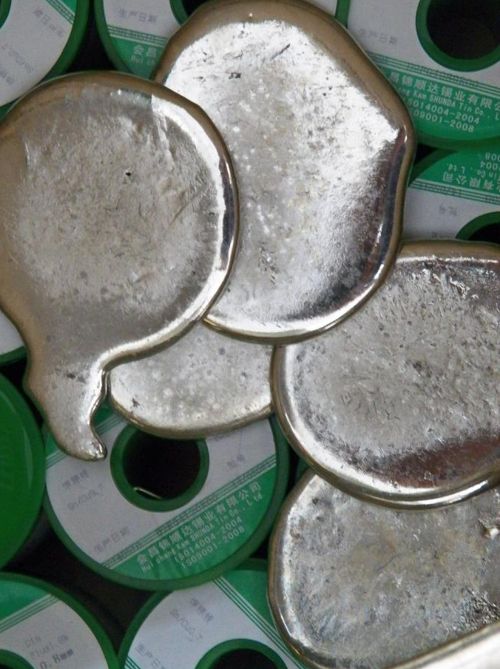
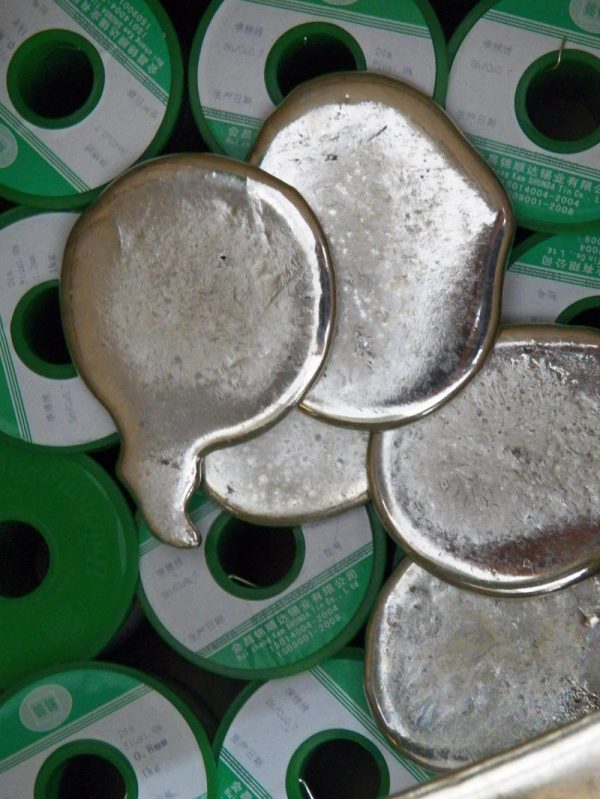
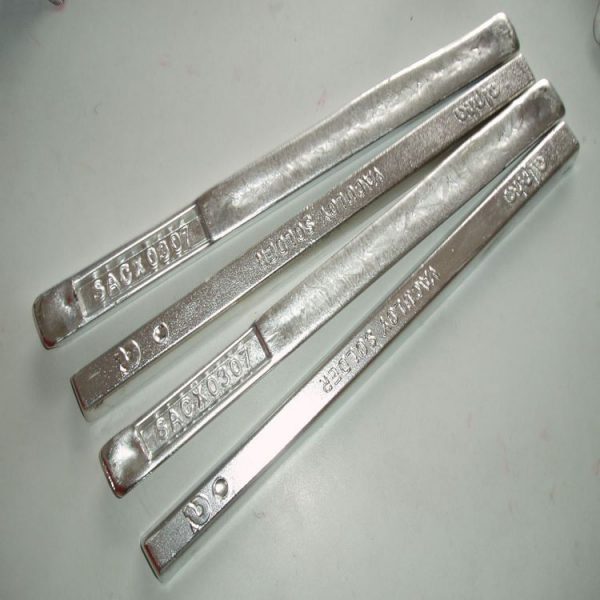
- Solder: Tin alloys with lead (now often lead-free, using tin with silver, copper, or bismuth) for joining metals in electronics, plumbing, and manufacturing.
- Pewter: Tin (85–99%) + antimony/copper, used for tableware and decorative items.
- Babbitt metal: Tin-based alloys with antimony and copper, used in bearings for machinery (reduces friction).
- Glass manufacturing: Tin is used in the “float glass” process, where molten glass floats on a bed of molten tin to produce flat, uniform sheets.
- Chemicals: Tin compounds (e.g., organotin compounds) are used as stabilizers in PVC plastics, catalysts in industrial reactions, and biocides in antifouling paints for ships (though many are restricted due to environmental toxicity).
- One of the earliest metals used by humans, with evidence of tin mining dating back to 3500 BCE in Turkey and Iran.
- The Bronze Age (c. 3300–1200 BCE) was defined by the widespread use of bronze, an alloy of tin and copper, which revolutionized tools, weapons, and technology.
- Its Latin name stannum gives rise to its chemical symbol “Sn” and terms like “stannous” (for tin compounds in the +2 oxidation state).
In summary, tin’s unique combination of low melting point, corrosion resistance, and alloying versatility has made it indispensable in manufacturing, construction, and heritage—from ancient bronze artifacts to modern electronics.





Reviews
There are no reviews yet.