

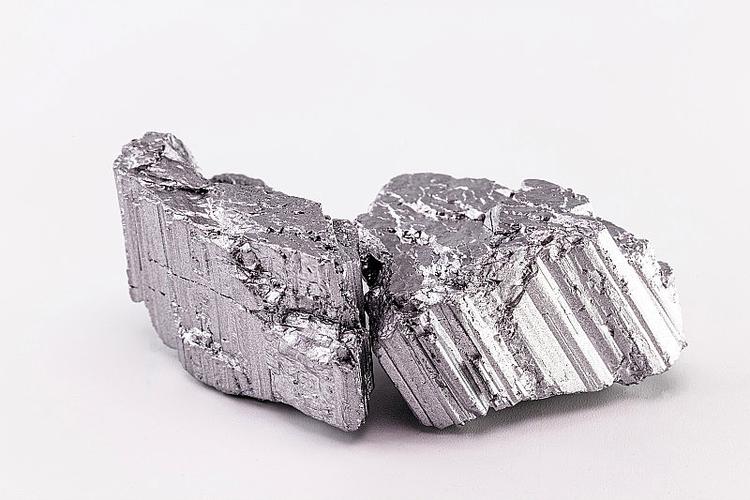
High-Temperature Stability of Praseodymium-Neodymium (Pr-Nd) Alloy: Mechanisms, Challenges, and Application Optimization
Praseodymium-Neodymium (Pr-Nd) alloy, as a critical component of Nd-Fe-B permanent magnets, directly determines the performance and reliability of these magnets in high-temperature environments such as electric motors, wind turbine generators, and aerospace applications. This article comprehensively analyzes the oxidation behavior, phase stability, magnetic property evolution, and optimization strategies of Pr-Nd alloy at elevated temperatures.
I. Mechanisms of High-Temperature Instability
1. Accelerated Oxidation Kinetics
Praseodymium (Pr) and Neodymium (Nd) are typical active rare earth elements with extremely low standard free energies of formation (Pr₂O₃: -1826 kJ/mol; Nd₂O₃: -1810 kJ/mol). Above 150°C, the surface oxidation rate increases exponentially, and the oxide layer growth follows a parabolic law: x² = k_p t. At 300°C, the rate constant k_p increases by 2-3 orders of magnitude compared to room temperature. The oxidation process occurs in three stages:
- Initial Stage (<200°C): Formation of a 5-10 nm amorphous oxide layer.
- Intermediate Stage (200-400°C): Crystallization into cubic Pr₆O₁₁ and Nd₂O₃, with a volume expansion of ~7.3%.
- Advanced Stage (>400°C): Oxidation front penetration along grain boundaries, forming an interconnected oxide network.
2. Phase Structure Evolution
Analysis of the Pr-Nd binary phase diagram (Fig. 1) reveals key phase transformations at high temperatures:
- Room Temperature to 400°C: The Double Hexagonal Close-Packed (DHCP) structure remains stable.
- 400-550°C: Partial transformation to a Face-Centered Cubic (FCC) phase.
- >550°C: Appearance of a liquid phase and grain boundary phase reconstruction.
Particularly, when the temperature exceeds the Curie temperature (Pr: 293 K, Nd: 292 K), increased magnetic moment disorder leads to the attenuation of saturation magnetization (M_s) according to the Brillouin function: M_s(T) = M_s(0) B_J ( (g_J μ_B J H) / (k_B T) ).
II. Patterns of Magnetic Property Degradation
In high-temperature service environments, magnetic property degradation exhibits three distinct stages:
| Temperature Range | Coercivity (H_cj) Decay Rate | Remanence Decay Rate | Primary Mechanism |
|---|---|---|---|
| 150-250°C | 0.3-0.5%/°C | 0.15-0.25%/°C | Magnetic moment deflection due to thermal fluctuations. |
| 250-350°C | 0.6-1.2%/°C | 0.3-0.6%/°C | Grain boundary phase softening and formation of reverse magnetization nuclei. |
| >350°C | 1.5-3.0%/°C | 0.8-1.5%/°C | Main phase decomposition and intensified oxidation. |
Typical data indicates that unprotected Pr-Nd alloy exposed to 300°C for 100 hours experiences a coercivity (H_cj) drop exceeding 40% and a maximum energy product ((BH)max) loss of up to 55%.
III. Stability Enhancement Technologies
1. Alloying Modification (Table 1)
Adding trace alloying elements significantly improves high-temperature performance:
Table 1: Influence of Alloying Elements on High-Temperature Properties of Pr-Nd Alloy
| Element Added | Optimal Content | Oxidation Resistance Improvement | Coercivity Increment | Mechanism |
|---|---|---|---|---|
| Cobalt (Co) | 0.5-1.2 at% | +200% | +15% | Formation of Fe-Co exchange hardening phase. |
| Dysprosium (Dy) | 0.3-0.8 at% | +150% | +25% | Increases magnetocrystalline anisotropy field. |
| Aluminum (Al) | 0.1-0.3 at% | +180% | +10% | Forms protective Al₂O₃ film. |
| Copper (Cu) | 0.2-0.5 at% | +120% | +8% | Optimizes grain boundary phase distribution. |
2. Surface Protection Technology
- Physical Vapor Deposition: Magnetron sputtering of TiN/Al₂O₃ multilayer coatings (single layer 50-100 nm) reduces the oxidation rate at 400°C to 1/20th of uncoated samples.
- Chemical Passivation: Phosphate conversion coating forming a PrPO₄·xH₂O protective layer, with salt spray resistance >500 hours.
- Organic-Inorganic Hybrid Coating: Sol-gel derived SiO₂/epoxy composite coatings enable long-term stable operation at 350°C.
3. Grain Boundary Engineering
Adding 0.5% Ga and employing a dual-alloy process homogenizes the distribution of the RE-rich grain boundary phase, increasing intergranular isolation to 92%. This improves the coercivity temperature coefficient β from -0.65%/°C to -0.35%/°C at 350°C.
IV. Testing and Characterization Methods
- Thermogravimetric Analysis (TGA): In 5% O₂/Ar atmosphere, the oxidation weight gain curve shows an inflection point at 285°C.
- In-situ X-ray Diffraction: Reveals the formation of the PrFe₂ phase at 450°C, leading to sharp magnetic performance decline.
- Magnetothermal Analysis: Measures the Curie temperature of Pr₁₅Nd₈₅ alloy as 310°C, with <5% deviation from theoretical calculation.
- Electron Probe Microanalysis: Identifies preferential oxidation along Pr/Nd segregation zones, with a diffusion coefficient D(300°C) = 1.2×10⁻¹⁶ m²/s.
V. Application Cases and Future Prospects
An optimized Pr-Nd-Dy-Al alloy used in an electric vehicle traction motor achieves the following at a peak operating temperature of 180°C:
- Magnetic flux decay rate <3% per 1000 hours.
- Power density retention >92%.
- Projected service life extended from 8,000 hours (conventional alloy) to 15,000 hours.
Future development directions include:
- Nanocomposite Structure Design: Developing Pr₂Fe₁₄B/α-Fe nanocomposite dual-phase alloys to enhance high-temperature stability via exchange coupling.
- AI-Assisted Optimization: Using machine learning to predict optimal compositions, with potential candidates like Pr₁₇Nd₇₅Co₅Al₃ already identified.
- Extreme Environment Applications: Researching carbide-reinforced Pr-Nd matrix composites for aerospace needs above 500°C.
Conclusion
The high-temperature stability of Pr-Nd alloy is constrained by a triad of oxidation kinetics, phase transformation thermodynamics, and magnetothermal effects. Through an integrated technical strategy of multi-element synergistic alloying, nanoscale surface protection, and grain boundary microstructure control, the practical operating temperature window can be expanded from the current 150-180°C to 200-250°C. With breakthroughs in third-generation permanent magnet design concepts, Pr-Nd-based alloys are expected to achieve short-term stable operation at 350°C before 2030, providing core material support for high-temperature electromagnetic systems. Subsequent research should focus on atomic-scale interface engineering and the establishment of extreme environment service databases, advancing the paradigm of material design from empirical trial-and-error to a computationally driven approach.
