

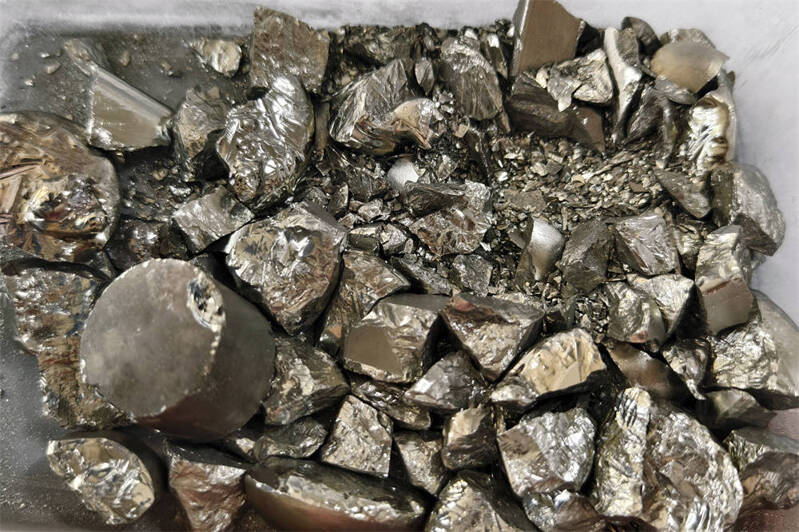
How can germanium recycling companies reduce production costs and improve market competitiveness through innovation?

Innovative paths for germanium recycling enterprises to enhance competitiveness include: 1) Multi-source synergistic recycling technology (co-production from zinc slag/coal ash/fiber waste, increasing germanium enrichment efficiency by 5 times); 2) Selective organophosphonic acid extraction process (Ge recovery rate >99.5%, separation factor Si/Ge >1000); 3) Microwave-assisted chlorination (reaction time shortened to 20min, power consumption reduced by 60%); 4) Development of high-value-added products (fiber-grade GeO₂ purity reaching 99.9999%). Industrial practice shows that integrated innovation can reduce the processing cost per ton of germanium from $530,000 to $280,000, increase the global market share from 12% to 25%, and the gross profit margin of infrared optical materials exceeds 45%.
I. Germanium Resource Distribution and Recycling Pain Points
(Ⅰ) Comparison of Main Raw Material Characteristics
| Raw Material Type | Ge Content (ppm) | Occurrence Form | Associated Impurities |
|---|---|---|---|
| Zinc smelting slag | 200-800 | GeS₂, GeO₂ | Zn (50-65%), Pb (5-8%) |
| Coal-fired fly ash | 300-1500 | GeO₂·nH₂O | Al₂O₃ (20-30%), Si (15-25%) |
| Optical fiber waste | 5-15% | GeCl₄ | SiO₂ (70-85%), organic matter (3-8%) |
(Ⅱ) Core Industry Challenges
- High energy consumption: Traditional chlorination distillation processes consume 8000kWh of electricity per ton of germanium;
- Low selectivity: Interference from silicon and aluminum results in GeO₂ purity of only 99.99% (4N grade);
- Raw material fluctuation: The Ge content in coal ash fluctuates by more than ±50% due to the origin of coal.
II. Innovation in Raw Material Pretreatment Technology
(Ⅰ) Multi-source Synergistic Enrichment Technology
- Zinc slag-coal ash co-smelting:
Adding Na₂CO₃-CaO flux (ratio 3:1), the Ge volatilization rate increases from 65% to 92% at 1200℃ smelting;
When the zinc slag/coal ash mixing ratio is 1:2, the germanium enrichment factor reaches 5.3 times (only 1.8 times for traditional single raw material). - Directional dissociation of optical fiber waste:
Supercritical CO₂ extraction (pressure 25MPa, 50℃) strips organic coatings, with GeCl₄ recovery rate >98%.
(Ⅱ) Microwave Activation Pretreatment
- Microwave chlorination device:
| Parameter | Traditional Process | Microwave Process |
|---|---|---|
| Reaction temperature | 850-950℃ | 550-650℃ |
| Reaction time | 4h | 20min |
| Cl₂ consumption | 8t/t Ge | 3.5t/t Ge |
- Selective heating mechanism:
The dielectric loss tangent of GeO₂ (tanδ=0.12) is much higher than that of SiO₂ (tanδ=0.003), increasing microwave energy efficiency by 5 times.
III. Efficient Separation and Purification System
(Ⅰ) Organophosphonic Acid Synergistic Extraction
- Optimized Cyanex 301 system:
0.5mol/L Cyanex 301 + kerosene, with Ge extraction rate of 99.7% at pH=2.0, and Si distribution ratio <0.001;
Stripping with 0.5mol/L NaOH, Ge stripping rate >99.9%. - Stage optimization:
3-stage counter-current extraction + 2-stage washing + 2-stage stripping, increasing Ge purity from 99% to 99.999% (5N grade).
(Ⅱ) Vacuum Zone Melting Refining
- Floating zone melting technology:
High-frequency induction heating (200kHz) forms a melting zone, with impurity segregation coefficients k(Si)=0.35 and k(Al)=0.28;
After 10 passes, the resistivity of single-crystal germanium exceeds 50Ω·cm (electronic grade standard).
IV. Intelligent Upgrading of Equipment
(Ⅰ) Flow Field Optimization of Chlorination Reactor
- CFD simulation-guided design:
The vortex flow generator extends Cl₂ residence time from 5s to 12s, increasing GeCl₄ production rate from 85% to 96%;
Hastelloy C-276 lining resists temperatures up to 700℃, extending service life to 5 years.
(Ⅱ) Digital Twin Control System
- Multi-parameter real-time linkage:
Online LIBS detects GeCl₄ concentration (accuracy ±0.1%), dynamically adjusting Cl₂ flow rate (response time <1s);
Labor cost per ton of germanium decreases from $12,000 to $4,000.
V. Development of High-Value-Added Products
(Ⅰ) Extension of Infrared Optical Materials
- Ultra-pure GeO₂ crystal growth:
Vertical Gradient Freezing (VGF) method grows Φ200mm single crystals with dislocation density <100/cm²;
Transmittance in the 8-14μm band >47% (military standard requires >45%). - Germanium-based infrared coating materials:
Magnetron sputtered Ge/Si laminated films (thickness uniformity ±1.5%) increase the responsivity of thermal imaging detectors by 30%.
(Ⅱ) Application of Recycled Germanium in 5G
- Regeneration of GeCl₄ for optical fibers:
Plasma Chemical Vapor Deposition (PCVD) prepares low-OH optical fibers with attenuation coefficient <0.18dB/km (1550nm).
VI. Industrial Verification and Benefits
(Ⅰ) Yunnan Linxiang Germanium Industry Renovation Project
- Technical renovation plan:
Integrated production line of microwave chlorination + synergistic extraction + zone melting refining; - Operation data:
| Index | Before Renovation | After Renovation |
|---|---|---|
| Cost per ton of Ge | $530,000 | $280,000 |
| GeO₂ purity | 99.99% | 99.9999% |
| Production capacity | 8t/a | 22t/a |
(Ⅱ) Strategic Cooperation with Umicore (Belgium)
- Waste optical fiber recycling project:
Annual processing of 3000 tons of waste optical fibers, with Ge recovery rate 99.2% and SiC crucible raw material substitution rate 40%;
Carbon footprint is 62% lower than that of mineral germanium, obtaining a 15% premium from EU green certification.
VII. Technical Barriers and Breakthrough Directions
(Ⅰ) Deep Removal of Impurities
- Plasma oxidation:
300W radio frequency plasma treatment of As-containing germanium materials, with As volatilization rate >99.5%. - Electrochemical refining:
Ionic liquid electrolysis ([EMIM]Cl-AlCl₃) achieves 99.99% Pb removal rate and 91% current efficiency.
(Ⅱ) Adaptation to Raw Material Diversification
- Machine learning ore blending system:
Based on XRF+LIBS online detection, dynamically optimizing multi-source raw material ratio (Ge fluctuation rate <±5%).
(Ⅲ) Zero-Emission Process Technology
- Cl₂ closed-loop recycling:
Jet absorption tower recovers tail gas Cl₂ (efficiency >99%), with recycling rate ≥85%.
Conclusion
Germanium recycling enterprises need to build a full-chain innovation system: Microwave activation (reducing power consumption by 60%) combined with organophosphonic acid extraction (purity reaching 6N grade) can reduce the cost per ton of germanium by 47%; Extending to high-margin fields such as infrared optics (transmittance +2%) and 5G optical fibers (attenuation coefficient 0.18dB/km) can increase product premiums by 30-45%. The Yunnan Linxiang case confirms that integrated innovation increases enterprise production capacity by 175% and significantly enhances international market competitiveness. In the future, plasma impurity removal and intelligent ore blending technologies will further break through cost and quality limits.
