

Gallium Extraction and Industrial Production Methods

Abstract: Gallium is a rare and dispersed metal that rarely exists as an independent mineral. It is primarily recovered as a by-product from bauxite, zinc ores, and coal fly ash. Core industrial extraction processes include amalgam electrolysis, ion exchange, solvent extraction, and neutralization precipitation. Currently, the dominant global production route, accounting for over 90% of primary gallium output, involves using Bayer process bauxite liquor as the main feedstock, followed by enrichment via ion exchange or solvent extraction, and finally electrolytic refining. As the world’s largest producer, China’s process innovations and environmental upgrades are leading industry trends. This article provides a systematic analysis of gallium’s primary sources, the principles and characteristics of various extraction technologies, and a detailed explanation of modern industrial production flows.
I. Industrial Sources of Gallium: A Dispersed Element Tied to Base Metals
Although gallium’s crustal abundance is comparable to lead, its highly dispersed nature precludes independent mining. Over 95% of global primary gallium (first extraction from ore) production is tied to the aluminum and zinc smelting industries.
- Bauxite Processing Liquor (Primary Source): Bauxite is the main raw material for alumina (Al₂O₃). During processing via the Bayer method, gallium coexists with sodium aluminate in the strong alkaline circulating liquor as sodium gallate (NaGa(OH)₄). As circulation cycles increase, gallium concentration can be enriched to ~200-300 mg/L, making this the most economical and significant source for extraction, accounting for ~90% of global production.
- Zinc Smelting By-product: Leach residues or flue dust from hydrometallurgical zinc production often contain minor amounts of gallium (100-1000 ppm). Specific leaching processes can bring gallium into solution for further recovery, a traditional source in some producing countries.
- Coal Fly Ash and Other Secondary Resources: Fly ash from the combustion of certain gallium-rich coals can contain appreciable gallium (up to 0.1%), extractable via acid or alkali leaching, representing a potential supplementary source. Furthermore, waste semiconductor materials (e.g., GaAs wafer scrap) are important sources for recycled gallium.
II. Analysis of Major Extraction Technologies
Enriching and separating gallium from the aforementioned solutions centers on the technical challenge of efficiently and selectively separating it from bulk elements like aluminum and zinc, to which it is chemically very similar. The table below compares the core features of mainstream processes:
| Process Name | Basic Principle | Advantages | Disadvantages/Challenges | Suitable Feedstock |
|---|---|---|---|---|
| Amalgam Electrolysis | Electrolysis of gallium-containing alkaline solution using a mercury cathode; gallium forms a liquid amalgam with mercury, later separated and distilled to yield metal. | Can directly yield high-purity metal; relatively short process flow. | High toxicity of mercury, significant environmental risk; largely obsolete. | Bayer Process Liquor |
| Ion Exchange | Uses specific chelating resins (e.g., amidoxime-based) to selectively adsorb gallium, followed by elution with acid or alkali. | Extremely high selectivity; can process low-concentration liquor directly; simple operation, high automation potential. | High resin cost; eluent requires treatment; demands clean feed solution. | Bayer Process Liquor, Acid Leach Solutions |
| Solvent Extraction | Uses specific extractants (e.g., Kelex 100, Cyanex 923) to complex with gallium in the organic phase, enabling phase transfer separation, followed by stripping for recovery. | High treatment capacity, high enrichment factor, suitable for continuous operation. | Complex process; requires strict pH control; potential for organic reagent loss/degradation. | Bayer Process Liquor, Zinc Smelting Solutions |
| Neutralization Precipitation | Introduces CO₂ or acid to gallium-containing aluminate solution, controlling pH to co-precipitate aluminum and gallium as hydroxides, followed by alkali re-dissolution for separation. | Lower cost, simple equipment. | Poor selectivity, incomplete Al/Ga separation, long process, lower Ga recovery rate. | Bayer Process Liquor |
Modern Industry Preference: Ion exchange and solvent extraction are the preferred technologies for new and mainstream gallium recovery projects due to their efficiency, environmental friendliness, and scalability. Ion exchange holds an advantage for Bayer liquor due to its superior selectivity and milder operating conditions, while solvent extraction excels with high-concentration or acidic solutions.
III. Full Industrial Production Flow: From Enrichment to High-Purity Metal
Modern industrial gallium production from Bayer process liquor typically involves four key steps:
- Enrichment & Separation:
- Filtered and cooled spent Bayer liquor is treated.
- Mainstream processes use ion exchange columns or extraction towers for continuous adsorption/extraction. For example, liquor passes through specialized resin columns where gallium is selectively retained, while impurities like aluminum pass through. After saturation, gallium is eluted using hot NaOH solution, yielding a concentrated gallium solution (enriched from mg/L to several g/L or tens of g/L).
- Purification & Precipitation:
- The concentrated gallium solution undergoes secondary purification (e.g., another extraction or precipitation stage) to remove impurities (e.g., V, Fe, Si) deeply.
- CO₂ or acid is introduced to adjust the pH to near-neutral/alkaline, precipitating gallium as gallium hydroxide (Ga(OH)₃). This is filtered and washed to yield crude gallium hydroxide.
- Dissolution & Electrolysis:
- The gallium hydroxide is dissolved in NaOH solution to prepare a high-purity sodium gallate electrolyte of suitable concentration.
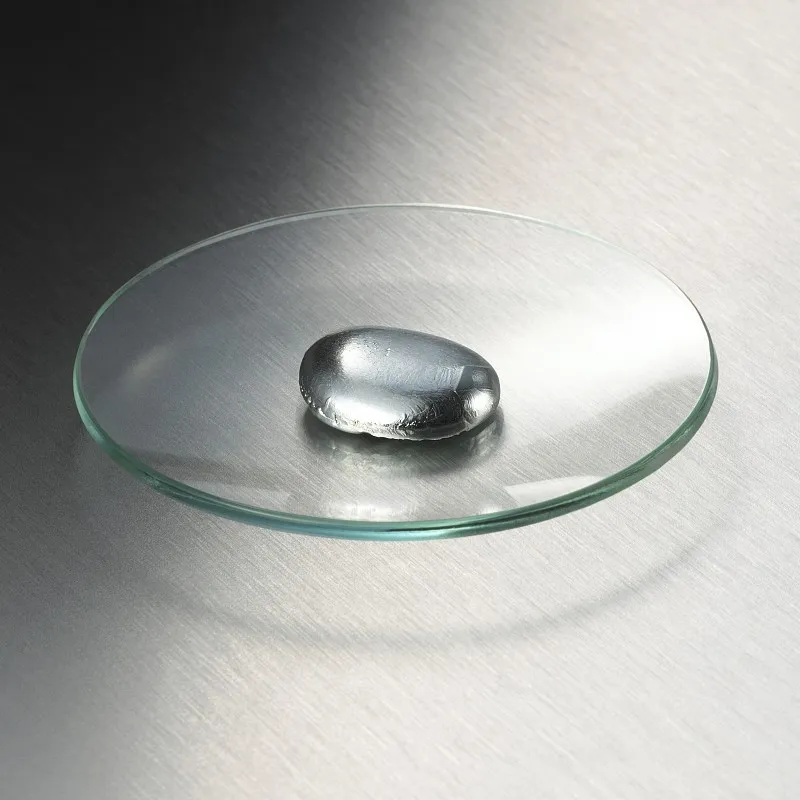
- In an electrolytic cell, using stainless steel cathodes and nickel anodes, electrolysis proceeds at specific current density, temperature, and cell voltage. Gallium deposits at the cathode and, due to its very low melting point (29.76°C), collects as a liquid at the cell bottom. It is periodically tapped to yield crude liquid gallium (99.9%-99.99% purity).
- Refining & Forming:
- Crude gallium, containing trace impurities like Na, Zn, Pb, Cu, undergoes further purification via methods such as acid/alkali washing, vacuum distillation, zone refining, or electrolytic refining.
- The final product is formed according to its use: Semiconductor-grade high-purity gallium (6N-7N, 99.9999%-99.99999%) is typically packaged in specialized polyethylene bottles under an inert atmosphere (e.g., nitrogen) for storage/transport to prevent oxidation. Industrial-grade gallium may be cast into ingots.
IV. Technological Challenges & Development Trends
Challenges:
- Extraction Efficiency & Economics: Cost-effective recovery from very low-concentration (ppm level), complex solutions is critical.
- Deep Aluminum-Gallium Separation: The high chemical similarity of aluminum and gallium makes complete separation a core process challenge.
- Environmental & Safety: Increasingly stringent requirements for managing organic extractants, treating wastewater, and preventing potential pollution.
Development Trends:
- Greener & Intensified Processes: Developing novel, greener extractants and resins with higher capacity, selectivity, and recyclability; exploring new technologies like membrane separation.
- Integrated Source Process Optimization: Implementing dedicated “gallium removal” steps within the alumina production flow (e.g., before precipitation) to pre-concentrate gallium, significantly reducing downstream extraction difficulty and cost.
- Rise of Secondary Resource Recovery: As waste from semiconductors, LEDs, and PV modules grows, efficient technologies for recovering gallium from these “urban mines” (e.g., hydrometallurgical leaching, vacuum metallurgy) are becoming R&D hotspots and important supplementary supply sources.
- Intelligent & Automated Control: Utilizing online analysis and automatic control technologies for precise, intelligent management of the extraction process, improving stability and recovery rates.
Conclusion
Gallium extraction and production represent a classic model of comprehensive resource utilization, its development inextricably linked to bulk metal industries like aluminum and zinc. The evolution from early, highly polluting amalgam processes to today’s efficient and cleaner ion exchange and solvent extraction methods has consistently centered on improving selectivity, reducing environmental impact, and controlling costs. Major producing nations, exemplified by China, are consolidating their dominant position in the global gallium supply chain through continuous process innovation and optimization. Looking ahead, robust demand growth driven by downstream sectors like 5G communications, new energy vehicles, and photovoltaics will propel extraction technologies toward greater efficiency, sustainability, and intelligence. This will also accelerate the maturation of circular economy models for recovering gallium from secondary resources.
