

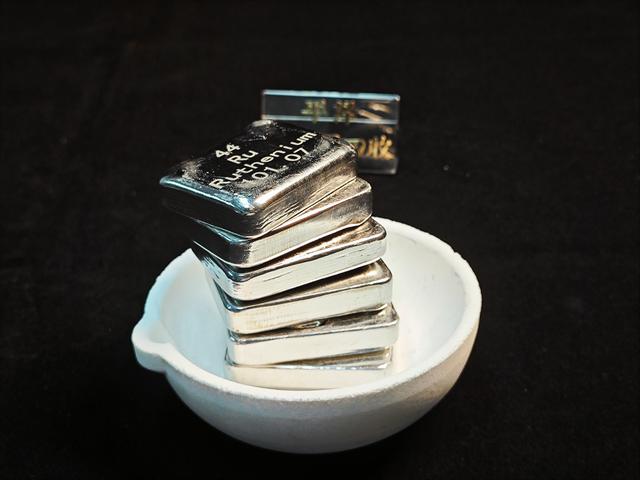
Comparative Advantages and Disadvantages of Ruthenium Among Platinum Group Metals

Abstract
Ruthenium (Ru), a critical member of the platinum group metals (PGMs), exhibits unique advantages in catalysis, electronics, and high-temperature materials, including:
- Exceptional catalytic selectivity (e.g., ammonia synthesis, organic hydrogenation);
- Ultra-low resistivity (7.6 μΩ·cm) and high hardness (6.5 Mohs), ideal for precision electrical contacts;
- Superior high-temperature stability (melting point: 2310°C), outperforming palladium (Pd) and rhodium (Rh).
However, its limitations include:
- Extreme scarcity (crustal abundance: 0.001 ppm), making extraction costlier than platinum (Pt);
- Chemical inertness, requiring aggressive processing (e.g., HF or molten salt electrolysis);
- Lower activity in certain applications (e.g., automotive catalysts) compared to Pt/Rh systems.
Future demand will be driven by Ru’s potential in hydrogen energy catalysts (e.g., HER) and ultra-high-density storage media.
1. Comparative Physicochemical Properties
A. Electronic Structure Advantages
- 4d⁷5s¹ configuration enables multiple oxidation states (+2 to +8), allowing flexible redox tuning in catalysis.
- Example: Ru/Al₂O₃ catalysts achieve 15% higher CO conversion than cobalt-based systems in Fischer-Tropsch synthesis, favoring light olefins.
- Versus Pt (4f¹⁴5d⁹6s¹): Ru’s d-electrons more readily participate in coordination, excelling in N≡N bond activation (e.g., 20% higher efficiency in Haber-Bosch ammonia synthesis).
B. Mechanical Properties
- Hardness: Ru (6.5 Mohs) > Pt (4.3 Mohs) and Pd (4.75 Mohs), making it superior for wear-resistant electrical contacts (e.g., HDD read heads).
- Resistivity: Ru (7.6 μΩ·cm) approaches iridium (5.3 μΩ·cm) at 1/3 the cost, ideal for IC diffusion barriers.
2. Unique Application Advantages
A. Catalysis
- Organic Synthesis
- Grubbs’ Ru-carbene catalysts enable 100% atom economy in olefin metathesis, whereas Pt/Pd require harsh conditions.
- Asymmetric hydrogenation: Ru achieves 99% ee selectivity for β-ketoesters vs. Rh’s 85% ee.
- Energy Catalysis
- Hydrogen evolution (HER): Ru@C catalysts show near-Pt performance (η₁₀ = 28 mV vs. Pt/C’s 25 mV) at 60% lower cost.
- Limitation: In automotive catalysts, Ru’s NOx reduction efficiency (80%) lags behind Pt-Rh systems (95%), with risks of volatile RuO₄ formation.
B. Electronics Industry
- Thin-Film Resistors & Electrodes
- RuO₂ films exhibit ultra-low TCR (±50 ppm/°C), outperforming Pt (±200 ppm/°C) in high-precision sensors.
- Drawback: Ru’s poor ductility (3% elongation) limits wire drawing vs. Pt.
- Magnetic Storage
- Ru interlayers enable 1 Tb/in² areal density (vs. Pt’s 500 Gb/in²), but plasma sputtering raises processing costs by 30%.
3. Resource & Processing Challenges
A. Extraction Difficulties
- <5% abundance in PGM ores; recovery requires volatile RuO₄ separation (300°C Cl₂ oxidation) at 65–70% yield (vs. Pt’s >90%).
- Vs. Ir: Ru’s 98% solubility in aqua regia aids purification but demands oxygen control (<10 ppm) during H₂ reduction.
B. Processing Limitations
- Melting point (2310°C) requires 2× more energy than Pd (1555°C) and electron-beam furnaces to avoid contamination.
- CMP challenges: Ru’s removal rate is 1/10 of Cu’s, hindering advanced-node adoption.
4. Future Prospects
A. Hydrogen Economy Catalysis
- Ru single-atom catalysts (Ru-N-C) achieve 0.82 V half-wave potential in ORR, nearing Pt/C (0.85 V).
B. Resource-Saving Strategies
- RuFe₃ alloys can cut PGM usage by 50%+ while maintaining performance.
Conclusion
Ruthenium’s unique electronic/mechanical properties secure its irreplaceable role in high-end catalysis and electronics, but scarcity and processing hurdles limit scalability. Future breakthroughs in nanostructuring (e.g., single-atom dispersion) and extraction (e.g., bioleaching) will be key to cost reduction. Within the PGM family, Ru’s differentiated strengths will elevate its strategic value in green hydrogen and next-gen storage technologies.
