

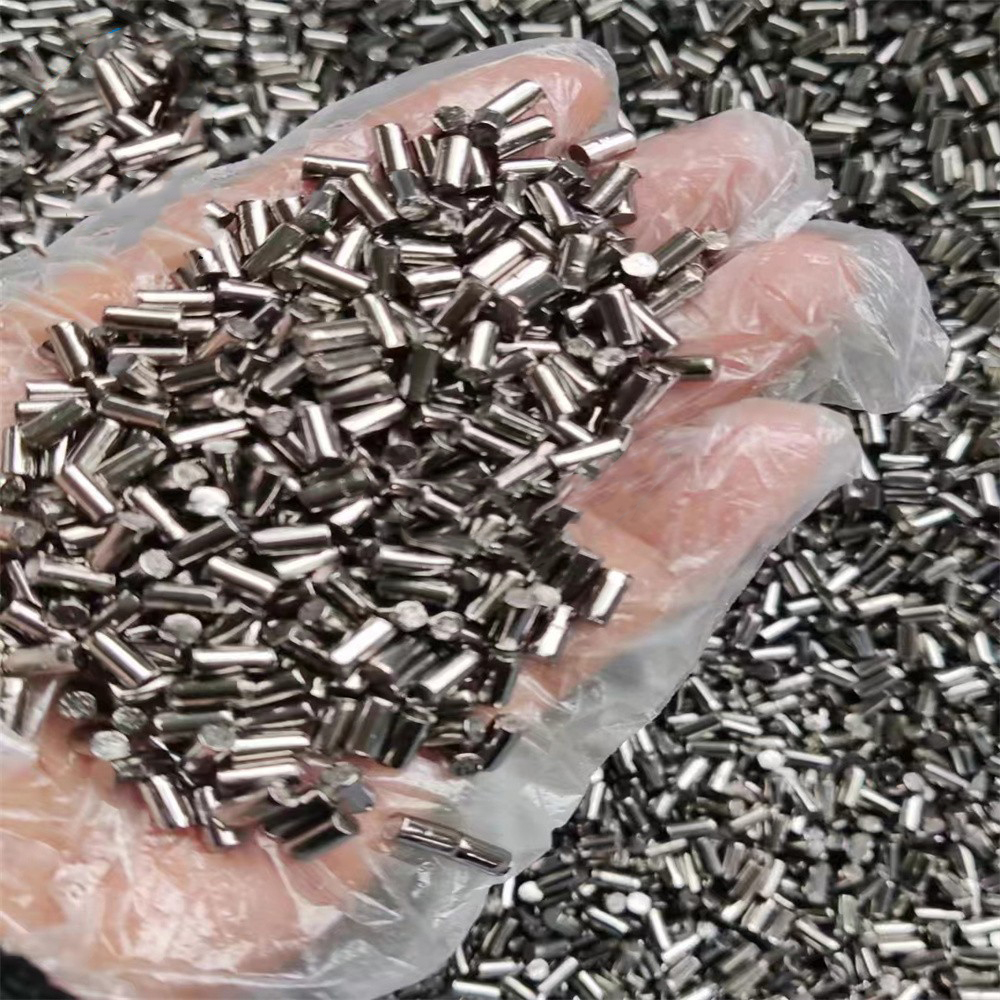
Differences Between Hafnium and Zirconium and Methods for Their Separation and Purification

Abstract
Hafnium (Hf) and zirconium (Zr), both Group IVB transition metals, share similar chemical properties. However, hafnium’s thermal neutron capture cross-section is significantly higher than zirconium’s (~600 times), leading to distinct roles in nuclear applications. These elements coexist in nature, primarily in minerals like zircon (ZrSiO₄). Key separation and purification methods include:
- Solvent extraction (e.g., MIBK-HNO₃ system) – The most widely used industrial method, capable of removing >99.9% Hf from Zr.
- Molten salt electrolysis – Separates Zr and Hf via selective deposition.
- Ion exchange – Achieves high-purity separation (>99.5%).
For nuclear-grade hafnium, further purification via iodide refining or electron beam melting is required to meet stringent standards (Hf content ≤0.01%).
1. Physicochemical Differences Between Hf and Zr
1.1 Nuclear Properties
- Hf: High thermal neutron capture cross-section (105 barns), making it ideal for nuclear reactor control rods.
- Zr: Extremely low neutron absorption (0.18 barns), used in fuel cladding materials (e.g., Zircaloy-2).
1.2 Physical Parameters
| Property | Hafnium (Hf) | Zirconium (Zr) |
|---|---|---|
| Density | 13.31 g/cm³ | 6.51 g/cm³ |
| Melting Point | 2227°C | 1855°C |
| Corrosion Resistance | Dissolves faster in HF | Highly resistant |
1.3 Electronic Structure
- Hf: [Xe]4f¹⁴5d²6s² – Additional 4f electrons enhance d-orbital splitting, increasing catalytic activity.
- Zr: [Kr]4d²5s² – Simpler electron configuration.
2. Separation and Purification Techniques
2.1 Solvent Extraction
- MIBK-HNO₃ System
- Zr/Hf chloride solution (50:1 ratio) mixed with methyl isobutyl ketone (MIBK) in 6 mol/L HNO₃.
- Hf selectively extracts into the organic phase; purity reaches 99.9% with >95% recovery.
- TBP Optimization
- Tributyl phosphate (TBP) in >8 mol/L HCl achieves a separation factor of 10³.
2.2 Molten Salt Electrolysis
- K₂ZrF₆-NaCl system at 700°C: Zr deposits on the cathode, enriching Hf in residual salt (~90% purity).
- Critical parameter: Current density <0.8 A/cm² to avoid Hf co-deposition.
2.3 Ion Exchange
- Dowex 1-X8 resin in 0.5 mol/L H₂SO₄: Hf forms [ZrO(SO₄)₂]²⁻ and is preferentially adsorbed.
- Elution: Stepwise gradient with 0.1 mol/L oxalic acid achieves >99.5% separation.
3. High-Purity Refining
3.1 Iodide Refining
- Crude Hf + I₂ vapor at 200°C → HfI₄ → Thermal decomposition at 1400°C → ≥99.99% pure Hf.
3.2 Electron Beam Melting
- Multiple vacuum melting cycles remove O, N impurities, meeting nuclear-grade standards (O ≤500 ppm).
4. Industrial Applications & Challenges
4.1 Nuclear-Grade Standards
- Nuclear Zr: Hf content ≤100 ppm.
- Nuclear Hf: Zr content ≤0.01%.
4.2 Resource Utilization
- Zircon contains only 1–2% Hf; low-grade ore extraction methods (e.g., bioleaching) are under development.
Conclusion
The separation of Hf and Zr is a classic challenge in similar-element chemistry. Future advancements will focus on:
- Green solvents (e.g., ionic liquids).
- Smart process control for aerospace and nuclear industries.
